Atlas 13-DOF Hands: What the Upgrade Means
Boston Dynamics has given Atlas 13-DOF hands with four fingers and tactile sensing. The useful question is whether that design survives factory work.
Boston Dynamics announced its Atlas 13-DOF hands on October 1. Each has four fingers, a four-DOF thumb, direct actuation and tactile pressure sensing on the fingertips and palm. That gives the humanoid more ways to reorient a part or hold a tool while operating its trigger, but it does not prove reliable factory output yet.[5]
What changed in the Atlas hand?
Atlas now has four fingers and 13 degrees of freedom: four in the opposable thumb and three in each other finger. Boston Dynamics replaced its previous seven-DOF hand to add in-hand object movement, more grasp options and tool handling without adding a fifth finger.[1]
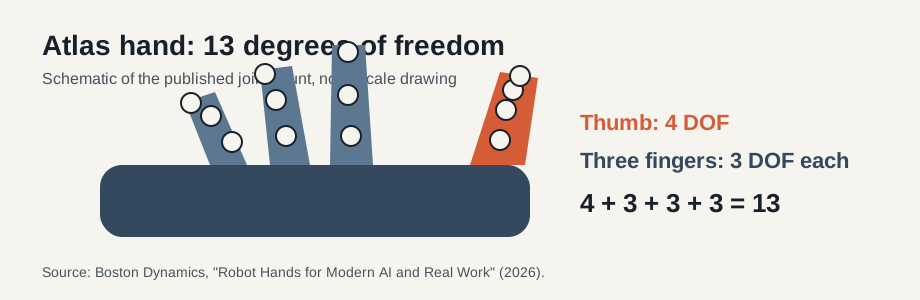
The number is not a score. Degrees of freedom describe separately controllable motions, not grip force, cycle time or task success. The important mechanical choice is the thumb. Boston Dynamics says its four joints can move against every other fingertip, supporting pinch and tripodal grasps.[1]
The company deliberately omitted a pinky. Its stated reason is pragmatic: another finger would add three actuators, along with more volume, power draw, cost and failure points. That is a design trade, not a declaration that five fingers never help.[1]
How does tactile sensing change a robot hand?
The new Atlas hand combines joint-based proprioception with dense pressure sensors over its fingertips and palm. In plain terms, the robot can estimate its own joint motion and sense contact at the hand. Boston Dynamics says this supports picking up small contact signals and adjusting a grasp.[1]
That matters when a part shifts, a drill handle rotates or an operator presents an object at an unexpected angle. Atlas already carries tactile sensing and a 360-degree camera view at the robot level, according to the published product specifications.[2][3]
A useful boundary remains. The company has described a prior Atlas demonstration in which the robot moved engine covers between containers and a sequencing dolly with online-generated motions, vision, force and proprioceptive sensing. That shows a defined material-handling task, not a broad measure of what the new 13-DOF hand can do across a factory shift.[4]
The hand can use tools, but factory value comes from repeatable completed tasks, not from the number of joints in a demo.
Why is Boston Dynamics training it in simulation?
Boston Dynamics designed the hand for high-fidelity simulation and sim-to-real reinforcement learning. Its claim is that direct actuation, backdrivable transmission and controls that compensate for friction and cogging let a simulated hand resemble the physical one closely enough to train policies before hardware rollout.[1]
That approach matters because collecting real contact-rich manipulation data is slow and expensive. A simulated policy can experience different object shapes, surface friction, torque profiles and disturbances before it touches a production part. The company says it has early promising results from dynamic sim-to-real tasks, but has not published an independent comparison, failure rate or production throughput for the new hand.[1]
Show data
| Previous hand | 7 |
|---|---|
| New hand | 13 |
What should a factory buyer ask next?
A factory buyer should ask for task-specific evidence: completed cycles, intervention rate, damage rate, recovery behavior, maintenance time and the conditions behind each figure. Atlas's published specification lists a 50 kg instantaneous capacity, 30 kg sustained capacity, a four-hour battery life and a 56-DOF robot body. Those figures set an envelope, not the output of a particular assembly task.[2][3]
The hand targets the awkward work that fixed grippers avoid: parts presented at changing angles, tools with triggers and objects that operators must turn after pickup. It will not make specialized automation obsolete. If a line already presents one part in one orientation, a dedicated end effector may still be cheaper and easier to validate.
Boston Dynamics frames Atlas as a product for material handling and says the robot can connect to manufacturing and warehouse systems through Orbit. Its product page also describes a sequence of application evaluation, training and integration. That sequence means the robot and the cell need their own qualification work.[2]
For the broader buying context, our warehouse humanoid explainer separates public deployments from shipment headlines. Our ISO cobot safety guide explains why a safety case belongs to the full application, not just the robot.
- 2024-04: Boston Dynamics introduces the electric Atlas platform for industrial work.[6]
- 2026-01: Atlas specifications list 56 body DOF, tactile fingers and palm, and up to 50 kg instantaneous capacity.[3]
- 2026-10: Boston Dynamics announces the four-finger, 13-DOF Atlas hand.[5]
The new hand is a credible engineering move because it targets the gap between picking an object and doing something with it. The unanswered question is operational: can Atlas complete those actions, recover from ordinary errors and stay available without human rescue? Boston Dynamics has not publicly supplied that record for this hand.[1]
Atlas 13-DOF hands: common questions
How many degrees of freedom does the new Atlas hand have?
Boston Dynamics lists 13 degrees of freedom: four in the opposable thumb and three in each of the other three fingers.
Does Atlas have tactile sensing in its hands?
Yes. Boston Dynamics says dense pressure tactile sensors cover the fingertips and palm. The robot also uses proprioception to estimate its own joint motion and force.
Why does the new Atlas hand have four fingers rather than five?
Boston Dynamics says a fifth finger would add three actuators and increase size, power use, cost and possible failure points. The company chose a four-finger layout for this design.
Does the 13-DOF hand prove Atlas can work in a factory?
No. The design and demonstrations show intended capabilities, but buyers still need task-specific data on completed cycles, intervention, recovery, maintenance and uptime.
Sources
- https://bostondynamics.com/blog/robot-hands-for-modern-ai-and-real-work/
- https://bostondynamics.com/products/atlas/
- https://bostondynamics.com/wp-content/uploads/2026/01/atlas-spec-sheet.pdf
- https://bostondynamics.com/video/atlas-goes-hands-on/
- https://m.ajupress.com/20261002102642532
- https://bostondynamics.com/news/introducing-electric-atlas/