EU Machinery Regulation Robots: Changes in 2027
EU Machinery Regulation robots face new rules for connected, autonomous and learning machinery from 2027. Makers and integrators need to know their duties.
EU Machinery Regulation robots will follow a product safety rulebook that replaces the Machinery Directive on 20 January 2027. The biggest changes concern connected control systems, autonomous behavior, learning safety functions and software records. The Regulation also makes the consequences of a major field modification more explicit.[1][2]
It applies to machinery placed on the EU market or put into service. Its legal form matters: the text applies directly across Member States. A directive first requires national laws to transpose it.[3]
What changes on 20 January 2027?
Machinery placed on the EU market before 20 January 2027 must comply with Directive 2006/42/EC. From that date, the Regulation becomes mandatory and replaces the Directive.[2]
The central process remains familiar. The manufacturer identifies the applicable essential health and safety requirements, assesses risk and builds the technical file. It then runs the appropriate conformity procedure, issues the EU declaration and affixes the CE marking.[1]
The legal form changes too. A regulation aims for the same text to apply across the EU, while the old directive depended on national transposition. That does not erase national enforcement or product specific law. It does reduce one layer of variation in the machinery rule itself.[3]
- 2023-06: The European Parliament and Council adopt Regulation (EU) 2023/1230.
- 2023-07: The Regulation enters into force, and an Official Journal corrigendum corrects 14 date references.
- 2024-01: Rules for notifying and supervising conformity assessment bodies begin to apply.
- 2024-07: Provisions for updating Annex I and related reporting processes begin to apply.
- 2026-10: Member States must notify the Commission of their penalty rules.
- 2027-01: The Machinery Regulation becomes mandatory on 20 January and replaces Directive 2006/42/EC.
The staggered dates come from Article 54 as corrected in the Official Journal. The Commission's machinery page confirms 20 January 2027 as the line for products placed on the market.[1][2]
Does every robot need third party certification?
No. Article 25 sets three routes based on Annex I classification. Machinery outside Annex I uses internal production control. Annex I Part B can also use internal production control when the design follows the relevant harmonized standards or common specifications that cover all applicable safety requirements. The other Part B routes involve a notified body.[1]
Part A is stricter. It contains six numbered categories, and each permitted conformity route involves a notified body. Two entries speak directly to machine learning. One covers safety components with fully or partly self evolving behavior that use machine learning to ensure safety functions. The other covers machinery containing such a system when no supplier placed that system on the market as a separate product. For the second entry, Part A concerns that embedded system.[1]
| Annex I position | What Article 25 permits | Robotics reading |
|---|---|---|
| Part A | Type examination plus production control, full quality assurance, or unit verification | A notified body participates in every listed route. The two machine learning safety entries sit here. |
| Part B | Internal production control under stated standards conditions, or one of three notified body routes | Classification and standards coverage decide whether internal control remains available. |
| Not in Annex I | Internal production control | The manufacturer still has to meet every applicable essential health and safety requirement. |
*Conformity routes and category counts: Regulation (EU) 2023/1230, Article 25 and Annex I.[1]*
This is narrower than "a robot uses AI." The Part A language attaches to machine learning used in a safety function. A vision model that sorts parcels differs from a learning component that decides whether a person is inside a hazardous zone. The presence of machine learning alone does not settle the classification. The system's function matters.
The Regulation does not put every AI enabled robot into the strictest route. It singles out machine learning that ensures a safety function.
What does cyber safety mean for a robot?
Annex III adds an essential requirement called protection against corruption. A connection to another device, including a remote device, must not lead to a hazardous situation. Hardware that carries access or data relevant to compliance critical software needs protection against accidental and intentional corruption. The same applies to critical software and data.[1]
The robot must also collect evidence of relevant interventions in that hardware, software or configuration. Its control system has to account for foreseeable malicious attempts by third parties when those attempts could create a hazard. This makes security part of machinery safety when a compromised connection or altered control rule can produce dangerous motion.[1]
That does not make a generic cybersecurity checklist sufficient. The required analysis starts with the hazard. For an autonomous mobile robot, a remote change to speed limits, localization data or protective field settings may affect safe stopping. For a fixed arm, the critical path may be a safety controller, an access mechanism or configuration data. The technical file should connect each protected asset to the risk it controls.
What must an autonomous robot record?
The Regulation separates two kinds of record. The tracing log for interventions and uploaded safety software versions must remain enabled for five years after an upload. The control system must keep a safety related decision record for one year after collection when it has fully or partly self evolving behavior. The text lets a competent national authority request these records only to assess conformity.[1]
Show data
| Safety decision records | 1 |
|---|---|
| Safety software logs | 5 |
| Technical documents and instructions | 10 |
The ten year bar combines obligations with different starting points. Manufacturers keep technical documentation and the EU declaration of conformity for at least ten years after market placement or putting into service. Digital instructions must remain online for the expected product lifetime and for at least ten years after market placement. Ten years is therefore a floor for instruction access, not a claim that every robot has a ten year lifetime.[1]
For sensor fed, remotely driven or autonomous machinery whose safety operations depend on sensor data, Annex IV adds another documentation item. The technical file must describe, where appropriate, the system's general characteristics, capabilities and limitations, along with the data, development, testing and validation processes used.[1]
That wording should change how a robotics team packages evidence. A test pass alone gives little context if the file does not identify the software version, operational limits, sensor assumptions and data behind it. The Regulation asks for a chain that a competent authority can inspect.
Can a software update make an integrator the manufacturer?
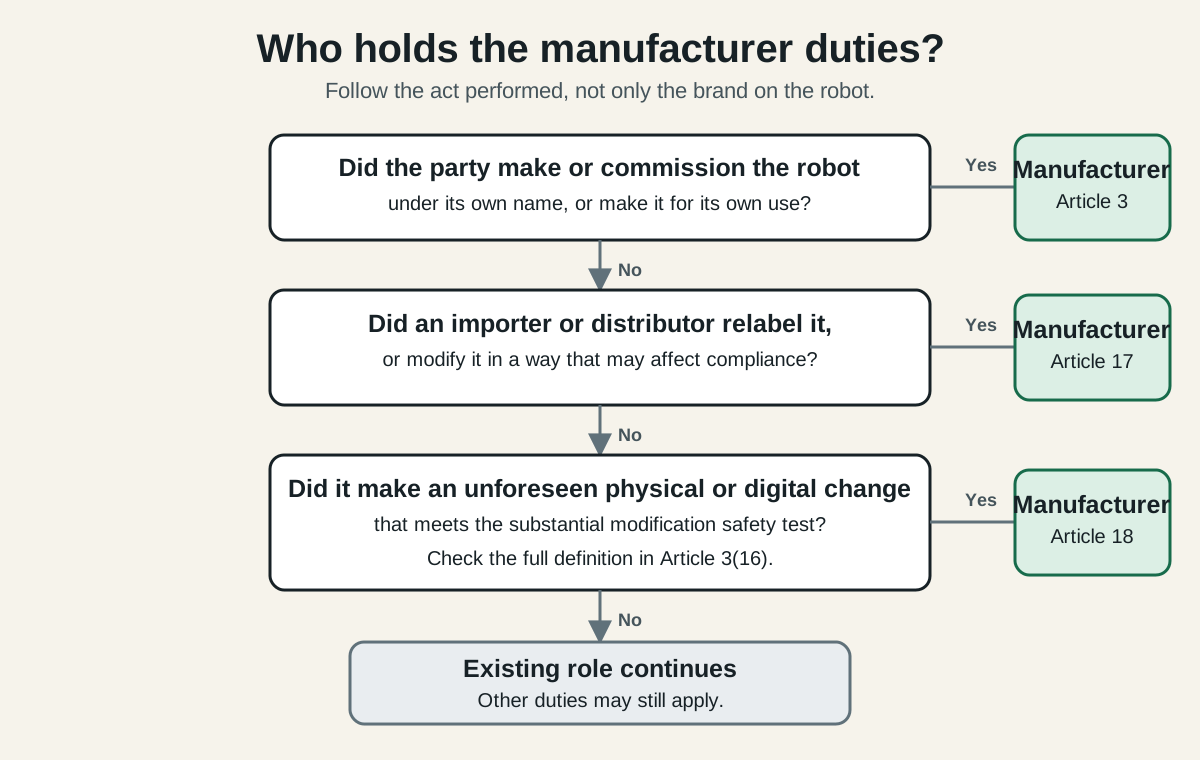
It can, but the threshold is specific. A substantial modification is a physical or digital change made after market placement or first use that the original manufacturer did not foresee or plan. It must affect safety by creating a new hazard or increasing an existing risk. That effect must require a qualifying change to guards or protective devices and the safety control system, or extra measures for stability or mechanical strength.[1]
The Regulation assigns the Article 10 manufacturer duties to a person or company carrying out that substantial modification. If the change affects only one machine in an integrated assembly, the risk assessment can demonstrate that narrower boundary. The rule does not assign these duties to a nonprofessional user who modifies a machine for personal use.[1]
Article 17 covers a different route. An importer or distributor becomes the manufacturer when it sells machinery under its own name or trademark. The same applies if it modifies a product and the change may affect compliance. Robot integrators should not assume that the name on the original arm or mobile base settles who holds the manufacturer duties after a system change.[1]
Are digital robot manuals enough?
The Regulation permits digital instructions, but it sets conditions. Users must be able to find, print, download and save them, including for access during a breakdown. The manufacturer must keep them online for the expected lifetime and at least ten years after placing the product on the market.[1]
A buyer can request a paper copy at purchase and receive it free within one month. Machinery intended for nonprofessional users, or foreseeably used by them, must still include essential safety information on paper. A QR code without durable offline access does not satisfy the digital instructions rule described in Article 10.[1]
Do harmonized robot standards still matter?
Yes. Compliance with a harmonized standard whose reference appears in the Official Journal creates a presumption of conformity only for the essential requirements that the standard covers. The standard is a route to showing compliance, not a substitute for identifying every applicable requirement.[1]
That distinction matters during the transition. A robot may follow a familiar Type C product standard and still need separate evidence for a new requirement that the cited standard does not cover. Teams should map requirements to evidence line by line instead of treating a standards list as a blanket approval.
What should robot teams do before 2027?
Start with the product boundary. Record which party places the robot or integrated cell on the EU market, who controls the design, and whether a later physical or digital change could meet the substantial modification test.
Then trace the safety chain through software. Identify connections and data whose corruption could cause a hazard. Put version history, intervention records, sensor limits and validation evidence into the technical file while engineers are building the system. If machine learning performs a safety function, classify that function against Annex I before selecting the conformity route.[1]
Finally, check dates at the point of market placement. The Commission says products placed on the EU market before 20 January 2027 remain under the Machinery Directive. Products crossing that line need the Regulation's requirements and documentation. A development schedule that ends in January 2027 has no room to leave that classification until final assembly.[2]
For the completed application and cell, see our cobot safety standards buyer guide. Teams evaluating mobile, actively stable machines can also use our legged robot safety standards guide.
EU Machinery Regulation robots: common questions
When does the EU Machinery Regulation apply to robots?
Regulation (EU) 2023/1230 becomes mandatory on 20 January 2027 for machinery placed on the EU market or put into service. Machinery placed on the market before that date remains under the Machinery Directive.
Does every robot need a notified body under the EU Machinery Regulation?
No. Article 25 provides internal production control for machinery outside Annex I. Annex I classification, and whether relevant standards or common specifications cover the applicable requirements, determine the available route.
Can a software update make a robot integrator the manufacturer?
It can when a post-market physical or digital change meets the Regulation's substantial modification test. The change must affect safety in the ways defined by the Regulation.
Are digital robot manuals allowed under the EU Machinery Regulation?
Yes, if users can find, print, download and save the instructions, including during a breakdown. Buyers may request a free paper copy at purchase, and some nonprofessional-use machinery needs essential safety information on paper.
Sources
- https://eur-lex.europa.eu/eli/reg/2023/1230/2023-06-29/eng
- https://single-market-economy.ec.europa.eu/sectors/mechanical-engineering/machinery_en
- https://osha.europa.eu/en/legislation/directive/regulation-20231230eu-machinery