Robotiq 2F-85 Newton Asset: What Changes
Robotiq's new 2F-85 Isaac Sim asset adds a Newton option for its linked fingers. Here is what that changes, and what it does not prove.
The Robotiq 2F-85 Newton asset is a newly published Isaac Sim model for a two-finger adaptive gripper. Robotiq provides PhysX and Newton physics backends for it.[1] The company says Newton preserves the gripper's closed-loop kinematics.[1] That helps teams test grasp behavior, but it does not make a simulated grasp a field validation.
Robotiq published the updated asset on September 22, 2026. The release sits beside the company's ROS 2 package and C++ SDK, which together form a vendor-maintained software path from gripper control to simulation.[1][2][3]
What is the Robotiq 2F-85 Newton asset?
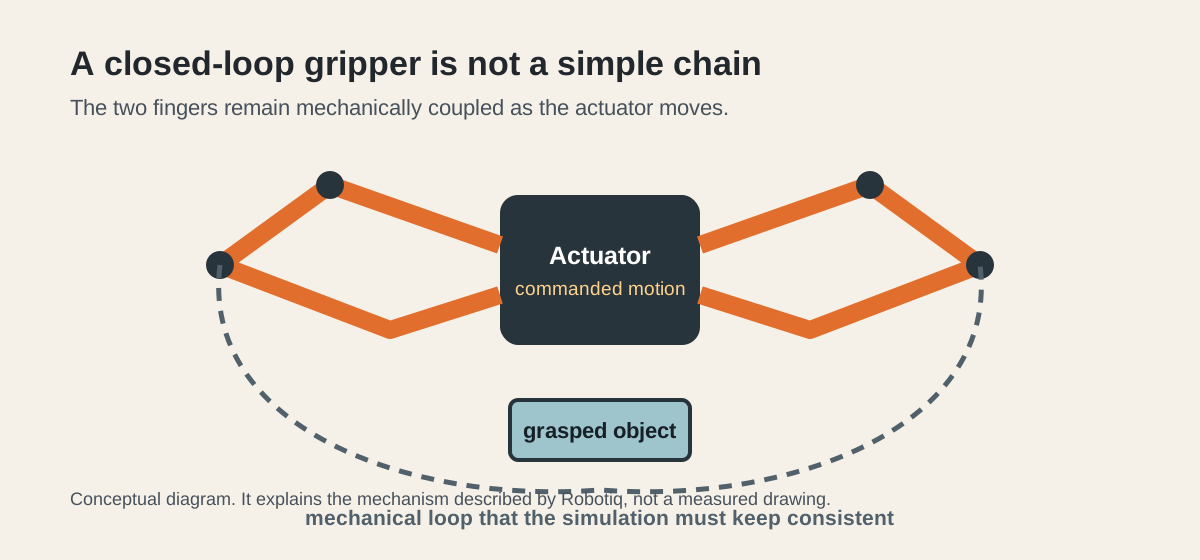
The Robotiq 2F-85 Newton asset is a maintained digital model of the 2F-85 adaptive gripper for NVIDIA Isaac Sim. Robotiq provides it on PhysX and Newton, two physics options within the simulator, and describes Newton as enabling precise closed-loop kinematics for this mechanism.[1]
The asset is not a new physical gripper or controller. It is simulation content. A developer can bring the model into an Isaac Sim scene, attach it to a robot wrist, and command its finger joint. Robotiq tells users to remove the gripper's articulation root when they mount it to an arm. That lets the arm and gripper solve as one articulation.[1]
The distinction is important because a gripper can look plausible in a static scene while behaving incorrectly when it closes around an object. Robotiq identifies backward bending, outward tip motion, and loss of alignment as failure modes users may see when a looped mechanism meets a solver designed around tree-like structures.[1]
Why do closed-loop kinematics matter for a gripper?
Closed-loop kinematics matter because linked parts carry the 2F-85's motion. The fingers do not each follow a separate motor command. If the simulator does not represent the constraints, an impossible finger pose can drive a simulated contact instead of the geometry and coupling of the real mechanism.[1]
That is a narrower claim than saying one backend is always better. Physics behavior depends on the model, contact settings, timestep, object geometry, and task. Robotiq says its asset needs Newton for precise closed-loop kinematics.[1] The release gives no cross-backend accuracy result, grasp-success benchmark, or sim-to-real transfer rate.[1]
Show data
| C++ SDK | 1 |
|---|---|
| ROS 2 package family | 1 |
| Isaac Sim physics variants | 2 |
The chart counts architecture elements, not capability. Robotiq describes Contact Core as including simulation assets, ROS 2 packages, and contact-rich data interfaces.[4] The new asset adds another configuration to that toolset.
"Command only finger_joint and let the loop closure solve the rest," Robotiq writes in its Newton asset setup notes.[1]
How does this connect to ROS 2 and the C++ SDK?
Robotiq's current software stack separates the job of controlling the gripper from the job of simulating it. Its open-source C++ SDK controls 2F-85, 2F-140, and Hand-E adaptive grippers over Modbus RTU, without requiring ROS.[3] The company says its ROS 2 hardware interface uses that SDK as a submodule.[2]
For an integrator, that layering can reduce duplicated device-control logic. A non-ROS application can use the SDK, while a ROS 2 system can use the vendor-maintained ROS layer. The simulation asset sits beside both tools. It provides a model to test in Isaac Sim, not a complete robot cell, application logic, or production acceptance test.[1][2][3]
| Layer | Robotiq's stated role | What an integrator still owns |
|---|---|---|
| C++ SDK | Controls supported adaptive grippers over Modbus RTU.[3] | Device connection, command limits, error handling, and application behavior |
| ROS 2 packages | Expose supported gripper control through ROS 2 and build on the SDK.[2] | Robot description, controllers, deployment configuration, and tests |
| Isaac Sim asset | Models the 2F-85 in PhysX or Newton for simulation.[1] | Scene setup, contact parameters, task data, validation, and real-cell commissioning |
Robotiq says the ROS 2 packages can replace the PickNik `ros2_robotiq_gripper` package without changing package names, launch files, or controller interfaces.[2] That is a manufacturer compatibility claim. Teams with existing workspaces should test their target ROS distribution, hardware, and controller configuration before they label a migration low risk.
What should a team test before trusting the simulation?
Use the Robotiq 2F-85 Newton asset to narrow questions before hardware testing. Does the gripper mount correctly on the robot model? Does the commanded joint behave as expected? Does the task remain stable across representative object geometry? The asset models the linked mechanism in Isaac Sim.[1]
The next step is not optional. Test on hardware with the actual gripper, objects, robot, guard design, and operating conditions. A simulated grasp does not measure cable routing, wear, calibration drift, communication faults, object variation, human access, or the protective measures required for a deployed cell. For an overview of how a buyer should frame the safety work around a robot cell, see our cobot safety standards guide.
A practical test plan should record software versions, physics backend, timestep, contact settings, robot model, mounting transform, objects, and the success definition. Those details make a simulated result interpretable. Without them, another team learns little from a claim that a policy or gripper behavior "worked in simulation."
- 2026-08-12: Robotiq publishes an open-source C++ SDK for supported adaptive grippers.[3]
- 2026-08-26: Robotiq publishes maintained ROS 2 packages built on that SDK.[2]
- 2026-09-22: Robotiq publishes the 2F-85 Isaac Sim asset with PhysX and Newton variants.[1]
- 2026-09-28: Robotiq plans to show its Physical AI work at IROS in Pittsburgh.[4]
What does the release not establish?
The release does not establish that the 2F-85 is the right gripper for every picking task. It does not disclose a comparison of grasp success, throughput, payload handling, or total integration cost against another gripper. It also does not turn a simulated result into independent validation of a real production deployment.[1]
That restraint is useful. The new asset answers a specific modeling problem for teams already using Isaac Sim and a Robotiq 2F-85. Its value depends on whether the team's scene, task, and hardware checks are close enough to the actual job. A close match can expose problems before a team spends time on a physical cell.
For readers building the rest of a simulation workflow, our Isaac Lab Arena adoption guide covers a separate question: whether an alpha benchmarking environment is appropriate for a team's evaluation process. The 2F-85 asset is a component model, not a substitute for that broader workflow choice.
Robotiq 2F-85 Newton asset questions
What is the Robotiq 2F-85 Newton asset?
It is a Robotiq-maintained 2F-85 gripper model for NVIDIA Isaac Sim that offers a Newton physics variant alongside PhysX. Robotiq says Newton supports precise closed-loop kinematics for the linked gripper mechanism.[1]
Does the asset prove that a 2F-85 will work on a real task?
No. It can support integration and task testing in simulation, but hardware commissioning is still needed to assess the actual robot, objects, operating conditions, and safety measures.
Can the asset replace the ROS 2 package or C++ SDK?
No. Robotiq presents the asset, ROS 2 packages, and C++ SDK as distinct pieces of its developer tooling. The SDK controls grippers, the ROS 2 packages provide a ROS layer, and the asset provides a simulation model.[1][2][3]
Sources
- https://blog.robotiq.com/robotiq-releases-new-2f-85-gripper-isaac-sim-assets-on-newton
- https://blog.robotiq.com/robotiq-releases-ros-2-packages-for-adaptive-grippers
- https://blog.robotiq.com/robotiq-releases-open-source-c-sdk-for-adaptive-gripper
- https://robotiq.com/contact-core-robotiq