Unitree H2 Industrial Mobile Manipulation Explained
Unitree H2 industrial mobile manipulation splits fixed, manually moved and wheeled dual-arm robots. The base choice matters for factory work.
Unitree H2 industrial mobile manipulation is a dual-arm platform offered as a fixed base, a manually moved chassis, or a wheeled mobile chassis. The important choice is not whether the machine looks humanoid. It is whether a factory needs arms at one station, arms that move between stations, or a walking body.[1]
The H2-A, H2-D Standard, and H2-D Flagship use different bases but share two seven-axis arms and a quoted rated payload of about 7 kg per arm. Unitree lists them as product configurations, not named customer deployments. That distinction matters for anyone reading a spec page as proof of factory performance.[1]
What is Unitree H2 industrial mobile manipulation?
Unitree H2 industrial mobile manipulation combines two robot arms with a base selected for a fixed work cell or for movement through a facility. Its H2-D Flagship is a wheeled mobile manipulator, not a legged humanoid, and Unitree targets production lines, warehousing, research, commercial service, and embodied AI training.[1]
A mobile manipulator joins a mobile base to one or more arms. That architecture is already familiar in industrial automation. The H2 Series puts it behind a humanoid label and adds a torso-like lift column, a head, cameras, and optional hands. None of that makes a task deployable on its own. The application still needs an end effector, a reachable part, a cycle target, and a safety design.
For a separate look at what is already documented in warehouse humanoid work, read our guide to humanoid robots in warehouses. The current evidence favors narrow jobs in controlled sites.
Why offer three bases for the same arms?
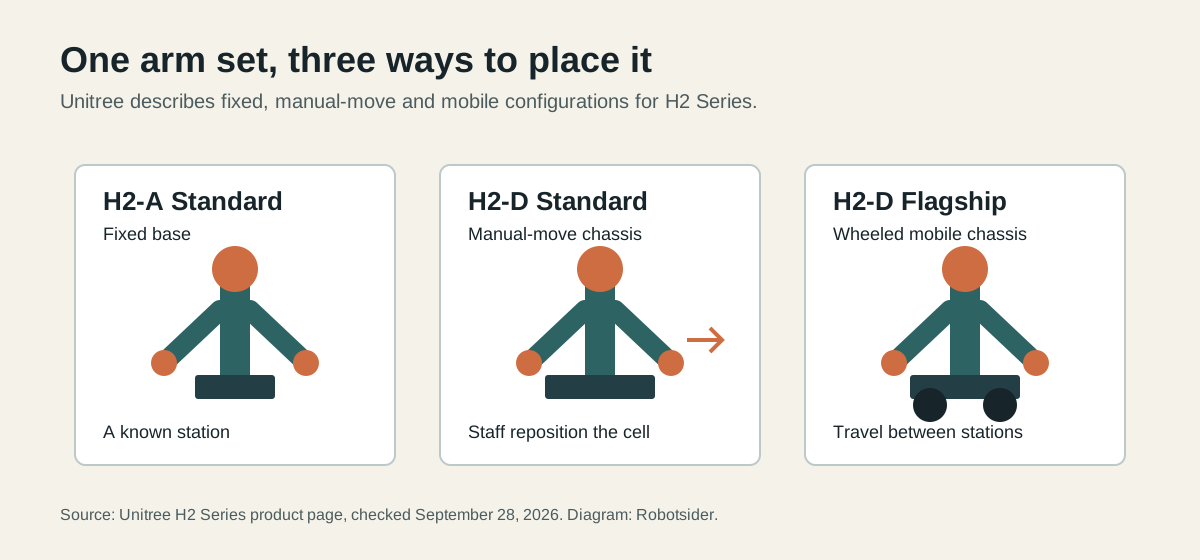
The three H2 Series forms answer different material-flow problems: H2-A stays at a workstation, staff move the H2-D Standard manually, and H2-D Flagship carries the arms on a powered chassis. A buyer should start with the work path, not with the most animated configuration.[1]
| Configuration | What Unitree lists | Better fit | What it does not establish |
|---|---|---|---|
| H2-A Standard | Fixed base, 19 degrees of freedom excluding end effector | One repeatable station | A deployed production cell |
| H2-D Standard | Manual-move chassis, 19 degrees of freedom excluding end effector | A cell that staff reposition | Autonomous travel |
| H2-D Flagship | Mobile chassis, 20 degrees of freedom excluding end effector | Work spread across stations | Unattended site performance |
*Configuration summary: Unitree H2 Series product page, checked September 28, 2026.[1]*
The fixed version removes navigation from the job. That can reduce integration scope when parts arrive at a known location. The manually moved version retains a compact cell while leaving transport to staff. The Flagship adds a dual-wheel differential drive, LiDAR, a depth camera, collision sensors, ultrasonic sensors, and a stated maximum speed of 1.5 m/s.[1]
Those additions expand the engineering task. The robot has to reach a station, understand its surroundings, stop or reroute when needed, and still position both arms accurately. A spec sheet can confirm that Unitree lists sensors. It cannot confirm the availability, recovery behavior, or throughput of a customer application.
Show data
| H2 Series rated per arm | 7 |
|---|---|
| G1+ standard | 3 |
| G1+ EDU | 4 |
The chart compares Unitree's quoted figures, not a test result. The H2 Series page says arm load changes with extension posture, so one payload number has limits.[1] Unitree lists 3 kg for the G1+ standard and 4 kg for the G1+ EDU. The H2 Series lists about 7 kg rated and 15 kg peak per arm.[3]
How does the H2-D Flagship move and reach?
The H2-D Flagship uses a dual-wheel differential drive, a lift column, and a pitching waist so its arms can work at different heights without legged locomotion. Unitree quotes a 0.46 m lift travel, about 0.6 m single-arm reach without dexterous hands, and a 0 to 115 degree waist pitch range.[1]
That arrangement makes the platform easier to compare with a wheeled mobile manipulator than with a biped. Its stated chassis turning diameter is about 0.75 m. The product page also lists 120 kg approximate weight with battery and a 1.44 kWh quick-release base battery for the Flagship.[1]
These figures answer only part of a buying question. They describe geometric range and hardware configuration. They do not say whether a gripper can grasp a particular SKU, whether the robot can meet a required cycle time, or how many operator interventions it needs. Those need application evidence from a pilot.
For a safety-focused way to frame that pilot, see our cobot safety standards buyer guide. It covers industrial robot systems, not H2, but its point holds: risk assessment belongs to the complete application, not a component list.
Is H2-D a humanoid robot or a mobile manipulator?
H2-D is best understood as a mobile manipulator with a humanoid upper-body layout. Unitree calls the family a dual-arm humanoid robot, but its Flagship has wheels instead of legs and its product options include a two-finger gripper, three-finger hand, or five-finger dexterous hand.[1]
The label affects comparison shopping. A conventional arm on a mobile platform may meet a task with fewer moving joints. A biped may earn its extra complexity when it must use stairs or spaces designed around human walking. The H2-D sits between those positions: more mobile than a fixed cell, but it does not ask the buyer to pay for balance control.
Our view: that is a sensible product split. Do not treat it as evidence that the H2-D is ready to run an unmodified factory. Unitree's public H2-D page gives product specifications and target applications. It does not identify a factory customer, an operating fleet, throughput data, or a safety certification.[1]
What should a factory test before buying?
A factory should test H2-D against the actual station, part presentation, end effector, and human workflow it would replace or support. The first trial needs useful work measures. A successful demo is not enough.
1. Define the handled object, grasp points, required reach, and allowed contact force. 2. Measure completed cycles, failed grasps, human recoveries, and charging or battery swaps during ordinary operation. 3. Test stops, access control, and restart behavior with the full cell layout in place. 4. Compare the resulting cost per handled part with a fixed arm, an AMR plus arm, or the current process.
Unitree says the H2 Series supports secondary development and publishes an H2 SDK guide with interfaces and development material. That supports engineering work, but an SDK is not a validated application package.[1][4]
- 2026-01: Unitree lists the H2 bipedal humanoid at US$29,900 in its official store.
- 2026-09: Unitree's support site shows an H2 SDK development guide updated September 3.
- 2026-09: Unitree's public H2 Series page presents fixed, manual-move, and mobile chassis configurations.
The practical reading of Unitree's H2 line
Unitree H2 industrial mobile manipulation is a configuration choice, not a single capability claim. The H2-D Flagship can move on wheels, lift its arms, and carry a quoted 7 kg rated load per arm. Whether that becomes useful factory automation depends on the part, the end effector, the workflow, and the safety case.[1]
The more useful comparison is not H2 against another humanoid on a show floor. It is H2-D against the simplest system that can complete the job. That might be a fixed arm. It might be an AMR with an arm. It might be an H2-D, if movement between stations pays for the extra system work.
Unitree H2 industrial mobile manipulation
What is the Unitree H2-D?
The H2-D is Unitree's dual-arm platform with either a manual-move chassis or a wheeled mobile chassis. The Flagship version has a dual-wheel drive base.
How much can the Unitree H2 Series lift?
Unitree lists a rated payload of about 7 kg per arm and a peak payload of about 15 kg per arm. It says the maximum load varies greatly with arm extension posture.
Is the Unitree H2-D a walking humanoid?
No. The H2-D Flagship uses a wheeled chassis. Unitree also sells a separate H2 bipedal humanoid.
Does Unitree publish H2-D factory deployments?
The H2 Series product page lists target applications and specifications, but it does not name a customer, an operating fleet, throughput results, or a safety certification.
Sources
- https://www.unitree.com/H2-D
- https://shop.unitree.com/products/unitree-h2
- https://www.unitree.com/G1pl
- https://support.unitree.com/home/en/H2_developer