Digit 5 Warehouse Safety Buyer Guide
Agility's new Digit 5 promises closer work with people. This buyer guide separates vendor claims from the site checks a warehouse still needs.
Digit 5 warehouse safety depends on a site-specific risk assessment, not on a product announcement. Agility Robotics says its new humanoid can work near people with human detection, motion cues and an independent safety controller. A buyer still needs to test the actual workflow, space, people and failure responses before changing barriers or procedures.[1]
Agility introduced Digit 5 on September 15, 2026. The company lists a 50 lb payload, 7.2 ft reach and a 10:1 run-to-charge ratio. It says the robot can perform work near people without the physical barriers used around conventional automation.[1][2]
This guide is a procurement and pilot checklist, not legal or safety-engineering advice. For a broader standards primer, see our cobot safety standards guide.
What does Digit 5 claim to change about warehouse safety?
Agility markets Digit 5 as a humanoid that can work close to people through person detection, visual and auditory motion cues, and an independent safety controller. That changes the questions a buyer must ask, but it does not replace them: the intended task, facility layout and foreseeable faults still determine the safety case.[1]
Agility says the detection system monitors for people and can avoid, stop or sit when someone enters an unsafe distance. Its announcement describes the motion controller as independent and names NVIDIA's Halos for Robotics platform as part of the planned safety architecture.[1] These are material claims, but the announcement does not publish a task-specific validation report, stop-distance data, detection coverage limits or a site approval for a buyer's workflow.
That missing detail is not an accusation. It is a normal procurement boundary. Ask the supplier which configurations, sensor placements, speeds, loads, end effectors and environmental conditions its evidence covers. Then test the chosen configuration where it will operate.
“A safety controller” is an architecture claim. A safe deployment is a property of the complete robot, task and workplace.
| Buyer question | What Agility publicly states | What the warehouse must establish |
|---|---|---|
| Person detection | Multiple sensor technologies monitor for people. | Detection coverage around racks, carts, blind corners, reflective surfaces and the chosen load. |
| Robot response | The robot can avoid, stop or assume a seated position. | Trigger conditions, stopping behavior, restart rules and recovery after a fault. |
| Working near people | Digit 5 is engineered for cooperative work in close proximity. | The specific work zones, pedestrian paths, supervision model and operating limits. |
| Payload and reach | Up to 50 lb payload and 7.2 ft reach. | The real load geometry, grip, center of mass, drop risk and the reachable hazard area. |
| Fleet integration | Agility offers its Arc fleet platform for warehouse systems. | Interfaces, loss-of-connection behavior, permissions, logs and change control. |
*Product claims: Agility Robotics, Digit 5 announcement and product page, checked September 16, 2026.[1][2]*
Which Digit 5 workflow should a buyer pilot first?
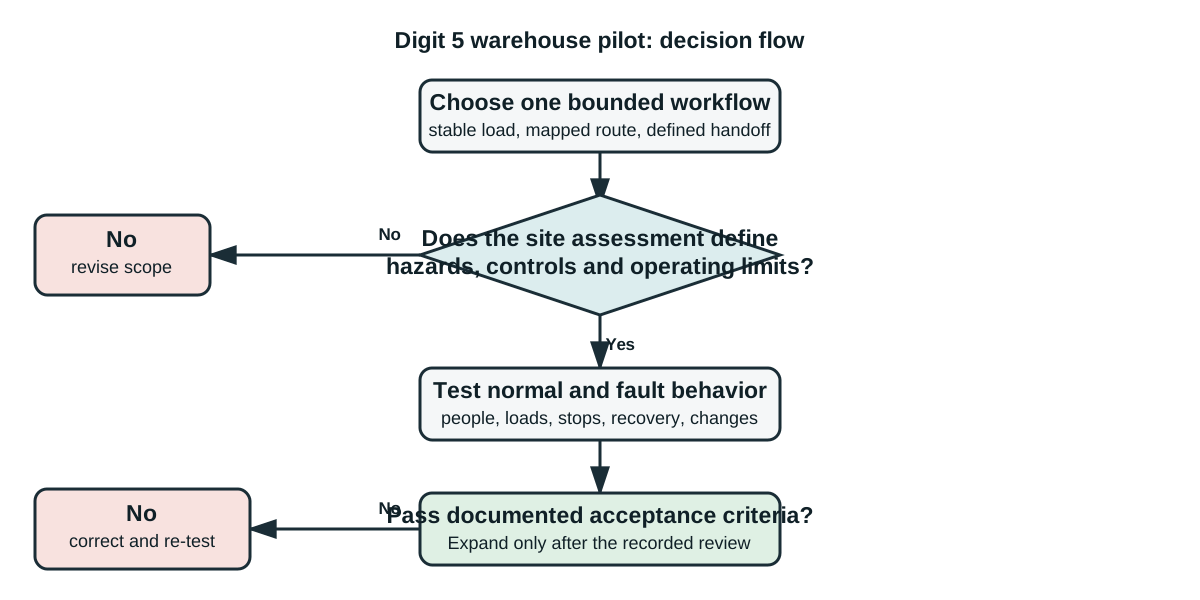
The best first Digit 5 pilot is a repetitive, bounded material-handling task with a mapped route, stable load and clear handoff. Do not begin with a job that mixes uncertain loads, dense pedestrian traffic and frequent manual intervention, because that makes it harder to tell whether a safety control or the operating process failed.
Agility says it plans to expand Digit 5 from tote handling to depalletizing, machine tending, kitting, sequencing, inspection and palletizing.[1] Those are different applications. A tote handoff on a defined route does not prove that a machine-tending cell, high-reach pick or depalletizing task has the same risk profile.
Use a pilot charter that names the item handled, maximum mass, grasp orientation, route, speed modes, handoff point, workers who can enter the area and the actions that stop the job. Record the result of every planned fault test. A vendor demonstration can inform that plan; it cannot substitute for it.
Can a buyer remove physical barriers around Digit 5?
A buyer should not remove physical barriers because Agility markets Digit 5 for cooperative work. In the United States, OSHA's general machine-guarding rule requires one or more guarding methods to protect workers from specified machine hazards. The applicable safeguarding method depends on the hazards in the actual operation and any more specific requirements that apply.[3]
OSHA 29 CFR 1910.212 names barrier guards, two-hand devices and electronic safety devices as examples of machine guarding. It also requires guarding where a machine's point of operation exposes an employee to injury.[3] The regulation is not a product certification for Digit 5, and it does not turn Agility's announcement into an approval for a particular warehouse.
The practical question is narrower: if the current barrier changes, what protection takes its place, and what evidence shows it protects every affected employee in every relevant mode? That review should include people who do not operate the robot, such as pickers crossing the aisle, maintenance staff and employees clearing a dropped item.
What should a Digit 5 acceptance test include?
A Digit 5 acceptance test should prove normal operation and safe behavior when a person, load, sensor, network or workflow does not behave as planned. Define pass and fail conditions before the robot arrives, then preserve logs, video where lawful and the configuration used in every test.
Agility says its Digit platform processes sensory data locally and sends system health and diagnostic information to Agility Arc. It also lists fleet metrics such as uptime, throughput and mean time between incidents.[1] Those platform features may help an operator investigate an event, but buyers should confirm the records available for their own deployment, their retention period and who can access them.
| Test area | Example acceptance question | Evidence to retain |
|---|---|---|
| People and route | Does the robot detect an entering worker across the whole approved route? | Test plan, maps, speed setting, outcomes and exceptions. |
| Load handling | Does it retain and place the heaviest approved load in the allowed orientations? | Load description, end effector, repetitions and failure record. |
| Fault response | What happens after a sensor fault, blocked path, dropped item or communications loss? | Alarm behavior, stop state, restart authority and recovery procedure. |
| Mode changes | Who can alter speed, payload, route, gripper or software? | Role permissions, change log and re-test trigger. |
| Operations | Can workers identify a robot's state and report a near miss? | Training record, reporting channel and escalation owner. |
*Acceptance-test questions are a recommended method. Public product facts cited in this guide come from Agility Robotics; the safeguarding context comes from OSHA.[1][2][3]*
A small pilot is useful only if the record can support a later decision. Capture configuration identifiers, software version, operating hours, interventions, near misses, task completion and every condition that caused a stop. Keep the denominators. “No incidents” says little without the number of hours, cycles, people and operating conditions observed.
For deployment context, our humanoid robots in warehouses explainer separates announced pilots from evidence of sustained operation. For a product-focused perspective, read our Unitree H2 Plus review, which uses the same distinction between a vendor specification and independent deployment evidence.
Is Digit 5 ready for a warehouse purchase decision?
Digit 5 is ready for a buyer to begin evidence gathering, not for a buyer to skip its safety and integration work. The public announcement gives useful specifications and describes the intended architecture, but it leaves the buyer's task-specific validation, safeguards, operating procedures and acceptance criteria unresolved.[1][2]
Agility reports more than $300 million in multi-year Digit 5 orders, subject to contractual milestones, and cites Digit 4 operating history. Those statements show commercial interest and prior platform operation. They do not establish that Digit 5 has completed a particular buyer's workflow or that every new configuration will perform safely at that buyer's site.[1]
Our view: buy a defined pilot only after the supplier and the warehouse agree on a written scope, configuration, test plan, incident process and expansion gate. The right first decision is whether the evidence package is sufficient to start a pilot, not whether a humanoid can replace a whole line.
Digit 5 warehouse safety questions
Is Digit 5 safe to operate around warehouse workers?
Agility says it designed Digit 5 for cooperative work through person detection, motion cues and an independent safety controller. Safe operation still depends on the specific task, configuration and workplace assessment. Do not treat a product claim as a blanket site approval.
Can Digit 5 work without a safety cage?
Agility says Digit 5 can work close to people without the physical barriers used by traditional automation. A buyer should not remove guarding until its qualified safety process has assessed the complete operation and applicable requirements.
What is Digit 5's payload?
Agility lists a payload of up to 50 lb, or 23 kg, and a reach of up to 7.2 ft, or 2.2 m. Load shape, center of mass, gripper and work area still affect the deployment assessment.
What should be tested before a Digit 5 pilot?
Test the approved route, loads, people entering the area, faults, stops, recovery, permissions and operator reporting. Preserve the software and hardware configuration for each test.
Does OSHA approve Digit 5?
This guide cites no public OSHA product approval. OSHA's machine-guarding rule sets general requirements for protecting workers from machine hazards; it is not a product certification for a particular robot.[3]
Sources
- https://www.agilityrobotics.com/content/agility-unveils-digit-5-humanoid-robot-built-for-cooperatively-safe-work-at-scale
- https://www.agilityrobotics.com/solutions/digit-5
- https://www.osha.gov/laws-regs/regulations/standardnumber/1910/1910.212