FORT Connectivity Aggregation Launches
FORT Connectivity Aggregation combines multiple network paths for remotely operated machines, but it does not replace a machine safety system.
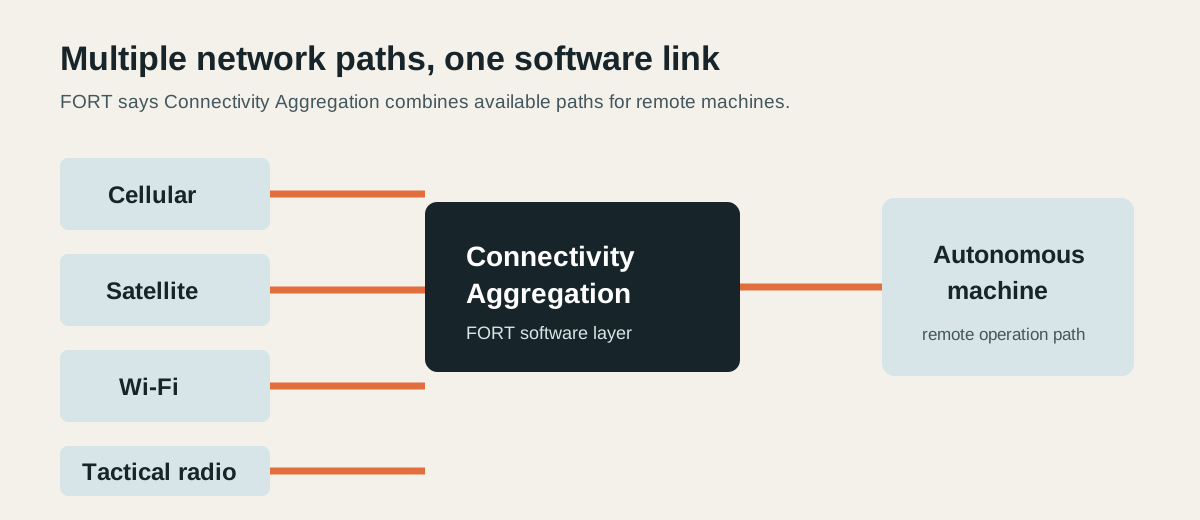
FORT Connectivity Aggregation is new software from FORT Robotics that combines cellular, satellite, Wi-Fi, and tactical radio connections for remotely operated and autonomous machines. FORT announced it at the AUSA Annual Meeting on October 14 and said it is in active rollout with defense customers, without naming them or publishing performance results.[1]
What did FORT Robotics launch?
FORT Connectivity Aggregation is a network software product, not a robot or a wireless emergency stop. Its stated job is to join multiple available IP network paths into one connection so a remotely operated machine can keep communicating when an individual path degrades.[1]
FORT's product page says the software can bond multiple cellular carriers with other IP networks. It also describes traffic classes that can prioritize video, telemetry, control signals, and operator audio differently.[2] Those are vendor descriptions. FORT has not published a test report with handover times, packet-loss results, supported hardware, or the conditions under which the service remains available.
"A dropped connection is annoying when you're talking with a friend. It's a very different problem when someone is remotely operating a 20-ton machine," FORT CEO Samuel Reeves said in the announcement.[1]
The company says customers can run the software on their own hardware, as a standalone product, or alongside its wider platform. It also says the product works with public and private networks and does not require proprietary devices or custom cellular links.[1]
Does redundant connectivity make a robot safe?
No. Connectivity can support remote visibility and intervention, but it does not by itself prove that a machine will stop safely, detect people, or behave safely after a communications failure. FORT itself separates remote human control from onboard "Inside-Out Safety" and environment-fed "Outside-In Safety" in its Trust Layer description.[3]
That distinction matters for buyers. The relevant questions are what the machine does when every path fails, which function retains authority locally, and how the installer validates the installation. FORT's announcement does not answer those questions. It describes the release as software for keeping communications available, not a substitute for the robot's safety architecture.[1]
For a buyer-oriented look at the standards that sit around collaborative machine safety, see our guide to ISO cobot safety standards. For a separate view of how operating conditions shape robot capability claims, see the Arm Robotics Capability Framework.
FORT Connectivity Aggregation questions
What is FORT Connectivity Aggregation?
It is FORT Robotics software that the company says combines cellular, satellite, Wi-Fi, and tactical radio paths into one connection for autonomous and remotely operated machines.
Has FORT published connectivity performance data?
Not in the October 14 launch announcement or the public product page reviewed for this article. FORT has not published uptime, latency, packet-loss, or failover measurements there.
Does connectivity aggregation replace robot safety controls?
No. A communications layer can support remote control and monitoring, but it does not replace local safety functions, risk assessment, or validation of a particular machine installation.
Sources
- https://www.fortrobotics.com/news/fort-robotics-expands-its-trust-layer-for-physical-ai-with-connectivity-aggregation-to-keep-autonomous-machines-reliably-connected-anywhere
- https://www.fortrobotics.com/connectivity-aggregation
- https://www.fortrobotics.com/trust-layer