RAIBO2 Marathon Robot Study Lands in Nature
KAIST's RAIBO2 ran a full marathon on one battery in 2024. A new Nature paper details how its hardware and control system cut energy loss.
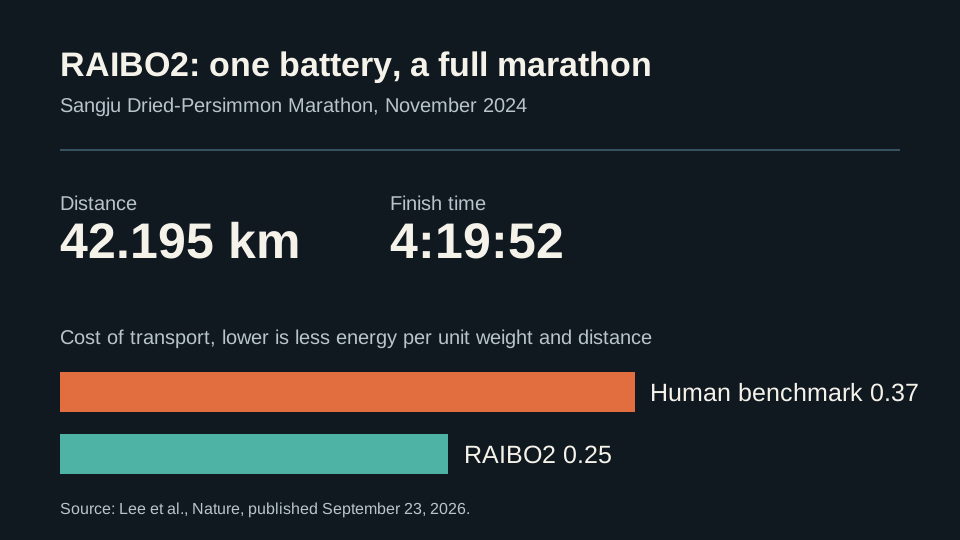
The RAIBO2 marathon robot, a KAIST quadruped, completed the 42.195 km Sangju Dried-Persimmon Marathon in 4 hours, 19 minutes and 52 seconds on one battery charge. The run took place in November 2024; a Nature paper published September 23 now explains the design behind it.[1]
The useful result is not a robot race time. It documents an attempt to reduce the energy losses that make legged machines short-range tools. The result comes from one research platform, not a commercial product.[1]
What did the RAIBO2 marathon robot prove?
RAIBO2 demonstrated that this particular quadruped could sustain a full marathon on one battery under real event conditions. It did not demonstrate a ready-to-buy inspection or rescue robot, nor does one run establish fleet reliability. KAIST registered the machine in the Sangju event and reported formal split timing, GPS-linked position data, and internal electrical and thermal data during the run.[2]
KAIST had announced its marathon attempt before the event. Its original target was the same full 42.195 km course. That gives the published result a clear before-and-after record, not a distance chosen after testing.[3]
"We demonstrated how the entire robot must be designed to achieve both high locomotion performance and energy efficiency," KAIST professor Jemin Hwang said.[2]
How did RAIBO2 stretch its battery?
The RAIBO2 marathon robot combines lightweight, force-transparent mechanical hardware, a low-resistance motor-driving circuit, and a locomotion policy that reduces energy dissipation. Nature reports a total cost of transport of 0.25, against the paper's human benchmark of 0.37.[1] The paper says RAIBO2 offers more than three times the travel range per charge of the existing quadrupeds in its comparison.[1]
Cost of transport is a normalized efficiency metric, not a battery label. It describes energy needed to move a unit of weight over a unit of distance. That makes it more informative than runtime alone when comparing legged systems with different masses and batteries. For a broader look at robot categories, see our service robot explainer.
Why the commercial claim remains open
The RAIBO2 marathon robot paper is a serious endurance result, but the authors do not present it as a production qualification. KAIST says its team hand-built RAIBO2 for research. A deployable product would need consistent results across multiple units and lower manufacturing cost.[2] It would also need to resist water and dust, tolerate temperature changes, survive shock and vibration, and meet EMI/EMC requirements.[2]
Those gaps matter most in the outdoor applications that long endurance makes plausible. A buyer assessing a field deployment still needs safety evidence, operating limits, maintenance terms, and application-specific testing. Our legged robot safety standards guide covers the standards question that a marathon result cannot answer.
RAIBO2 marathon robot FAQ
Frequently asked questions
How far did RAIBO2 run on one battery charge?
RAIBO2 completed the full 42.195 km Sangju Dried-Persimmon Marathon in 4 hours, 19 minutes and 52 seconds without charging or replacing its battery.
Is RAIBO2 a commercial robot?
The sources do not disclose a commercial RAIBO2 product. KAIST describes it as a hand-built research robot and says the team must do more work before it can make repeatable industrial products.
Sources
- https://www.nature.com/articles/s41586-026-11102-5
- https://www.eurekalert.org/news-releases/1145279
- https://news.kaist.ac.kr/newsen/html/news/?mode=V&mng_no=41590