Autonomous Airport Towing: What TLD Robotics Changes
TLD Robotics unifies EasyMile, TractEasy and TLD driverless work. Here is what that means for autonomous airport towing and what it does not prove.
Autonomous airport towing uses a driverless vehicle to pull baggage or cargo equipment along defined routes while fleet software assigns work and the operator retains responsibility for the site. TLD Robotics launched on September 16 after ALVEST acquired EasyMile, bringing EasyMile, TractEasy and TLD's driverless activities under one organization.[1]
The change is corporate, but it matters operationally. Airport projects can join a vehicle maker, autonomy supplier, integrator and local operating team. TLD Robotics says it will combine those functions for its autonomous ground operations offer. That may simplify purchasing and accountability. It does not establish that a specific airport route is safe, approved or ready for unattended operation.
What changed with TLD Robotics?
TLD Robotics is the new ALVEST company announced at GSE Expo Europe. It groups the EasyMile autonomy business, the TractEasy joint-venture activity and TLD's driverless work, with Richard Reno as chief executive officer.[1] In the prior arrangement, EasyMile said it supplied the autonomous-driving stack for TLD vehicle platforms and TractEasy sold the resulting towing solutions.[4]
That makes the launch easier to read as a change in commercial structure than as a new robot launch. The named hardware and software existed before the announcement. What changes is the company that presents the package, handles existing TractEasy engagements and says it will develop the next vehicle platforms.[1]
The announcement reports more than 35 operations in 10 countries and more than 50,000 autonomous missions. Those are company-reported totals, and the release does not disclose a common date range, route length or intervention rate for the missions.[1]
Show data
| Peak-day missions | 120 |
|---|
TLD's existing deployment record matters more than the rebrand. EasyMile reported in April that two EZTow vehicles at Lufthansa Cargo Frankfurt had run for more than a year, completing up to 120 autonomous missions on peak days. That is a useful operating example, although it does not tell a buyer how the system will perform at another airport or in another traffic pattern.[2]
How does autonomous airport towing work?
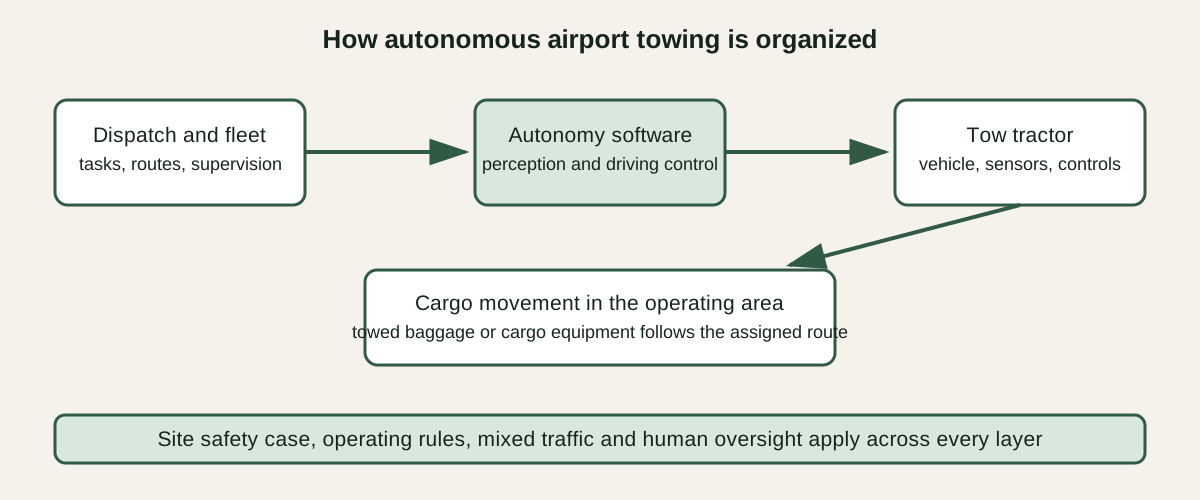
Autonomous airport towing is a material-movement system, not a vehicle working alone. A dispatch or fleet layer assigns a job. The autonomy stack perceives the environment and controls the tow tractor. The vehicle moves a dolly, trailer or other cargo equipment across the approved operating area. People still define the routes, rules, escalation process and response to abnormal conditions.
TLD's EZTow page describes support from project definition through installation, integration and daily operations. The company also describes the vehicle as a platform co-developed by TLD and EasyMile.[3] This is why a buyer should examine the whole service boundary, not only a brochure for the tractor.
A driverless tow tractor is one component. The deployable product is the vehicle, software, operating rules and support model together.
A useful comparison comes from industrial robot safety: a robot and its completed application are different scopes. Airport towing has the same practical lesson. A vehicle specification cannot settle hazards created by cargo types, crossings, ramps, weather, dispatch interfaces or mixed vehicle and pedestrian traffic.
Why does one accountable supplier matter?
One accountable supplier can make it clearer who owns vehicle changes, software updates, fleet tooling and front-line support. This matters when a project spans both outdoor and indoor routes or must connect with an airport's existing operational systems. TLD Robotics says the combined organization will develop the vehicle and software together, then plan, build, deploy and scale autonomous operations.[1]
The benefit is not automatic. A consolidated supplier may reduce coordination work for the airport, but it can also concentrate dependency on one commercial and technical relationship. Buyers should ask how the vendor exports data, staffs local service, identifies updates that require revalidation and handles replacement of a vehicle, sensor or software component.
The term "autonomous" also needs a concrete operating definition. EasyMile's Frankfurt announcement describes a live cargo deployment with two EZTow vehicles, but public material does not provide a complete safety case, incident history or the intervention process for every route.[2] Those omissions do not show a defect. They show why a buyer cannot turn an operating reference into a blanket capability claim.
What should an airport ask before buying autonomous towing?
Start with the site, not the marketing category. The direct answer is that an airport should require a written description of the route, cargo, traffic conditions, remote-support model and evidence boundary before comparing any autonomy claim.
1. Which routes, crossings, surfaces and weather conditions were within the prior deployment evidence? 2. What cargo equipment, tow load and coupling process are in scope for the proposed configuration? 3. Who has authority to stop, recover or reroute a vehicle when an operating condition changes? 4. Which interfaces connect dispatch, fleet management, airport operations and maintenance teams? 5. What evidence supports the safety assessment for this site and this use case? 6. Which service levels, spare parts and software-update responsibilities does each party carry under the contract?
That list prevents a common error: treating an aggregate mission count as a measure of fit for a new operation. Robot-density statistics have a similar limitation. A large total can show scale, but it does not reveal the conditions behind a single deployment.
What TLD Robotics does not change
The launch does not remove the need for local approvals, site procedures or a completed risk assessment. It also does not change the evidence available to the public. TLD Robotics reports operating scale and the Frankfurt reference demonstrates that an EZTow deployment has run in a demanding cargo setting.[1][2] Neither source proves a universal safety result, a particular cost reduction or a timeline for another airport.
Our view: the notable part of this announcement is the attempt to package a mature autonomy partnership as one supplier. That is a practical move in a market where vehicle, software and operations support can otherwise arrive through separate contracts. The meaningful test will be whether the combined company can publish comparable deployment evidence, clear responsibility boundaries and repeatable site outcomes.
- 2017: TLD and EasyMile begin the collaboration that later supplied the TractEasy operating model, according to TLD Robotics.[1]
- 2023: TLD Robotics says the parties formed TractEasy three years before the September 2026 announcement.[1]
- 2026-04: EasyMile reports up to 120 autonomous missions on peak days at Lufthansa Cargo Frankfurt.[2]
- 2026-09-16: ALVEST announces TLD Robotics after acquiring EasyMile.[1]
Autonomous airport towing: common questions
What is autonomous airport towing?
It is the use of a driverless tow vehicle, autonomy software and fleet operations to move baggage or cargo equipment on defined airport routes. The vehicle is only one part of the system. Site rules, supervision and recovery procedures still matter.
What changed when TLD Robotics launched?
TLD Robotics combined EasyMile, TractEasy and TLD driverless activities under ALVEST. The company says it will offer vehicles, autonomy software, deployment expertise and support through one organization.
Does a live airport deployment prove a system will work at another airport?
No. A reference can show that a configuration operated at one site, but it cannot establish the safety, approval status, cost or performance of a new route. Buyers need evidence for their own cargo, traffic, operating rules and local requirements.
Sources
- https://tracteasy.com/news/tld-robotics-launched-as-alvest-group-acquires-easymile-and-tracteasy
- https://easymile.com/en/news-insights/easymile-powers-120-daily-autonomous-missions-at-lufthansa-cargo-frankfurt
- https://tracteasy.com/eztow
- https://easymile.com/en/news-insights/easymile-confirms-strategic-pivot-to-autonomous-heavy-duty-vehicles-enters-new-growth-phase