AWS Physical AI Toolchain: What It Does
AWS's new Physical AI Toolchain packages robotics training, simulation and edge deployment, but teams still own the robot, data and safety case.
AWS's Physical AI Toolchain is an open-source collection of reference architectures, infrastructure code and deployment automation for robotics teams using AWS and NVIDIA software. It joins data preparation, training, simulation and edge deployment into a repeatable workflow. It does not supply a finished robot behavior or prove that a policy is safe on a real machine.[1]
What is the AWS Physical AI Toolchain?
The AWS Physical AI Toolchain is infrastructure for moving robot-learning work between stages without rebuilding the cloud plumbing each time. AWS calls it robot- and task-agnostic: a team brings its own robot description, teleoperation recordings and task. It provides a deployment pattern, not a capability layer that gives every robot new skills.[1]
AWS published the project on October 7. Its stated components include reference architectures, Infrastructure as Code and deployment automation, integrated with NVIDIA's GR00T for vision-language-action training, Isaac Sim, Isaac Lab, Cosmos and OSMO.[1]
The public repository uses an Apache-2.0 license. Its prerequisites include an AWS account with GPU quota, an NVIDIA NGC API key and a Hugging Face token, so "open source" does not mean a cost-free or account-free test drive.[2]
How does the toolchain move a robot policy to deployment?
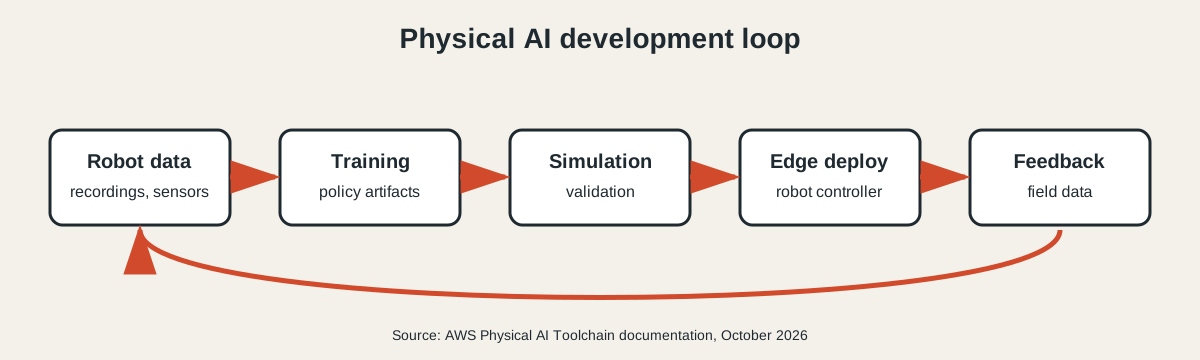
The workflow starts with data, trains or fine-tunes a policy, tests that candidate in simulation, then sends an optimized artifact to an edge controller. The controller runs inference near the robot while operational data can return to cloud storage for another training cycle. AWS's diagram names seven steps from simulation training through redeployment and monitoring.[3]
AWS describes its project as a flywheel rather than a fixed build pipeline. In its sample path, a team converts Zarr, ROS bag or CSV recordings to LeRobot v2 and stores them in S3. It can fine-tune a GR00T model on demonstrations, then export a policy for fleet deployment through Greengrass.[2]
The separation between cloud and robot matters. AWS says the cloud coordinates training and fleet management, while latency, power and thermal limits bind motion inference to the robot or nearby edge hardware.[1]
Show data
| Ingest | 1 |
|---|---|
| Imitation learning | 2 |
| World generation | 3 |
| Reinforcement learning | 4 |
| Deployment | 5 |
Reproducibility across the handoffs is the goal. A simulator, a trained checkpoint and a field deployment need a traceable relationship.
Which robotics tools and formats does it use?
The toolchain combines AWS services with NVIDIA's robotics stack, but it also uses familiar robotics and machine-learning formats. AWS says it accepts Zarr recordings, standardizes them to LeRobot, uses PyTorch and Hugging Face for training, describes robots with URDF and exports ONNX for portable inference. ROS 2 carries models into on-robot control.[1]
That portability claim has limits. The project targets AWS services for its execution layer, including EC2 GPU instances, SageMaker or Batch, EKS, S3 and IoT Greengrass. Teams can take their data formats elsewhere, but AWS designed the supplied automation around its infrastructure.[1]
AWS's own guidance places Isaac Sim and Isaac Lab on GPU-backed EC2 for simulation and reinforcement learning. It describes Greengrass on physical controllers as the one-way deployment path, then sends sensor and video data back through AWS services for retraining and monitoring.[3]
| Stage | Example tooling AWS names | What the team must supply |
|---|---|---|
| Data ingest | Zarr, ROS bags, CSV, LeRobot, S3 | Task recordings and data governance |
| Training | GR00T, SageMaker, AWS Batch | Model choice, dataset and evaluation |
| Simulation | Isaac Sim, Isaac Lab, EC2 or EKS | Robot model, scenes and test cases |
| Edge deployment | ONNX, Greengrass, ROS 2 | Controller integration and rollout controls |
*Tooling examples: AWS Physical AI Toolchain documentation and sample repository, checked October 10, 2026.*
Isaac Lab Arena 0.3 is a separate guide to an Isaac Lab benchmark, while our Jetson Thor vs. AGX Orin comparison covers two edge-compute options mentioned by many robot-learning teams.
Does the toolchain solve sim-to-real or robot safety?
No. It can organize the simulation-to-deployment loop, but it cannot establish that simulated results will survive a production floor, a new object or a sensor fault. AWS itself describes the offering as infrastructure patterns and architectural guidance, not finished robot behaviors. A robotics team still owns test coverage, rollback rules and its application safety case.[1]
Simulation lets teams test more situations before hardware trials. It also leaves a gap: the physical world brings sensor noise, latency, calibration error, wear and conditions that a scene may not represent. AWS's guidance proposes monitoring and retraining after deployment, which is an operational process, not a safety certification.[3]
Buyers should ask for evidence outside the cloud diagram: completed task cycles, failure modes, human interventions, model version history and the conditions that halt the machine. For a deployed system, those records say more than a smooth training curve.
- 2026-10-07AWS introduces the Physical AI Toolchain and publishes the project documentation
- 2026-10-10Robotsider review date; the public repository lists 85 commits and no tagged release
Who should use the AWS Physical AI Toolchain?
This toolchain suits teams building learned robot policies that need a repeatable AWS-based route from demonstrations and simulation to an edge deployment. It is a poor first step for a company that has not defined a task, collected representative data or chosen how it will validate the robot around people and equipment.[1]
A small team can start with a single module instead of the entire stack. AWS says teams can deploy its modules independently and includes a GR00T example with 27 UR3 pick-and-place teleoperation episodes. The example teaches the mechanics, but it does not show that the same setup will work for a different arm, gripper, camera placement or production task.[1]
Our view: AWS has packaged a real source of friction, the messy handoff between robotics data, simulation jobs and deployment artifacts. The package does not remove the hard work. It moves the question from "how do we wire this together?" to "what evidence says this policy belongs on this robot at this site?"
AWS Physical AI Toolchain questions
Is the AWS Physical AI Toolchain open source?
Yes. AWS links to a public sample repository that uses the Apache-2.0 license. Running the supplied paths still requires cloud resources and credentials for some NVIDIA and model-download services.
Does it work with any robot?
AWS describes it as robot- and task-agnostic because teams bring their own URDF, recordings and task definition. Practical compatibility still depends on the team's control stack, hardware and integration work.
Does the toolchain make a robot safe?
No. It provides development and deployment infrastructure. Safety validation, task risk assessment, real-world testing and application controls remain with the robot operator and integrator.
What does AWS use for edge deployment?
AWS names IoT Greengrass for edge deployment and ROS 2 for on-robot control in its toolchain materials.
Sources
- https://aws.amazon.com/blogs/physical-ai/introducing-aws-physical-ai-toolchain
- https://github.com/aws-samples/sample-the-physical-ai-toolchain-on-aws
- https://docs.aws.amazon.com/solutions/physical-ai-for-robotics-on-aws