Jetson Thor vs AGX Orin: Which Developer Kit?
Jetson Thor vs AGX Orin comes down to memory, power and measured workload fit. Compare NVIDIA's developer kits, prices, software and what can ship.
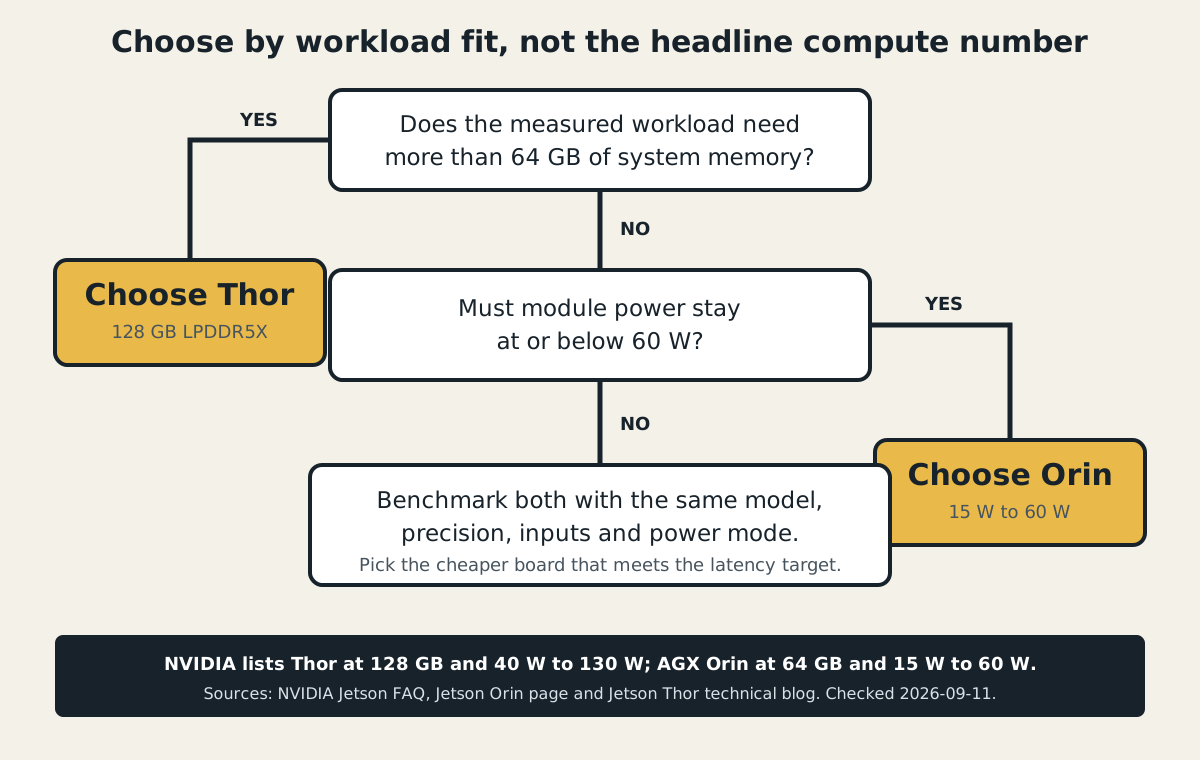
Jetson Thor vs AGX Orin is a workload decision, not a contest between 2,070 FP4 TFLOPS and 275 TOPS. Choose NVIDIA Jetson AGX Thor when a robotics prototype needs more than 64 GB, Blackwell features or more local model capacity. Choose Jetson AGX Orin when 64 GB and 60 W meet measured needs.[1][2][3]
We recommend AGX Orin by default. Thor costs more, permits a much higher power draw and earns its place only when a representative model or sensor pipeline exceeds Orin's limits. NVIDIA lists the developer kits at $5,499 for Thor and $3,499 for AGX Orin in its current FAQ.[1]
For examples of the bounded jobs these computers may support, read our survey of humanoid robots in warehouses.
Which Jetson developer kit should you buy?
Jetson AGX Orin should be the default purchase when the complete robotics workload fits within 64 GB and reaches its latency target at no more than 60 W. It costs less in NVIDIA's current US list and can emulate modules in the Jetson Orin family, which suits teams targeting Orin hardware.[1][2]
Buy Thor when testing shows a specific need for 128 GB, Blackwell's FP4 path, or concurrent workloads that benefit from the T5000 GPU. NVIDIA lists 2,070 sparse FP4 TFLOPS, a 14 core Arm Neoverse V3AE CPU and 273 GB/s memory bandwidth for the T5000 in the Thor kit.[3]
Do not buy Thor only because 2,070 looks larger than 275. NVIDIA reports Thor in FP4 TFLOPS and AGX Orin in TOPS. Precision, sparsity, model shape, software and power mode all affect useful throughput. A purchase decision needs a model benchmark, not division between those two headline numbers.
| Decision factor | Jetson AGX Thor Developer Kit | Jetson AGX Orin Developer Kit | What it means for a robotics prototype |
|---|---|---|---|
| Listed price | $5,499.[1] | $3,499.[1] | Spend the difference only after a representative workload misses a documented target on Orin. |
| AI figure published by NVIDIA | Up to 2,070 sparse FP4 TFLOPS.[3] | Up to 275 TOPS.[2] | Do not treat the figures as directly comparable. Benchmark the same model and precision. |
| Memory | 128 GB LPDDR5X, 273 GB/s.[3] | 64 GB LPDDR5, 204.8 GB/s.[2] | Thor leaves more room for large models and concurrent pipelines. |
| Module power range | 40 W to 130 W.[3] | 15 W to 60 W.[2] | Orin fits a lower power ceiling. Size the full system's battery and cooling separately. |
| CPU | 14 core Arm Neoverse V3AE.[3] | 12 core Arm Cortex A78AE.[2] | Profile CPU bound middleware and preprocessing instead of assuming the GPU decides everything. |
| Current common software branch | JetPack 7.2, Jetson Linux 39.2.[4] | JetPack 7.2, Jetson Linux 39.2.[4] | A common release reduces one migration variable, but hardware specific validation remains necessary. |
| Use in a finished product | Developer kit is not intended for use in a finished product.[1] | Developer kit is not intended for use in a finished product.[1] | Plan the deployable module, carrier board, thermal design and tests as separate work. |
When does 128 GB make Jetson Thor worthwhile?
Jetson AGX Thor's 128 GB is the clearest reason to choose it over Jetson AGX Orin. Move up when the complete robotics workload cannot stay within Orin's 64 GB, or when Orin leaves too little headroom for sensor buffers, middleware and updates. Measure peak memory before deciding.[2][3]
Measure the whole process. Model weights are only part of the footprint. Record peak device and system memory while the robot runs the intended camera streams, planning loop and logging setup. Then leave a margin for software updates and workload spikes. NVIDIA does not specify how much margin your project needs.
If 64 GB is comfortable, memory alone does not justify Thor. Move to latency tests at the same precision and batch behavior you expect on the robot.
How do power and cooling affect the choice?
Jetson AGX Orin is the better fit when compute must stay under 60 W. NVIDIA gives its module a 15 W to 60 W range, while the T5000 in the Thor kit spans 40 W to 130 W. Those figures exclude the rest of the robot's power demand.[2][3]
A mobile robot team should set a compute power ceiling before it orders hardware. Include the board, storage, networking, sensors, actuators, power converter losses and cooling in the system budget. Then test the target power mode. A model that reaches the latency target only at Thor's upper range may demand changes elsewhere in the robot.
AGX Orin is the safer first purchase when 60 W is already close to the compute budget. Thor makes more sense for a mains powered prototype, a vehicle with a larger energy budget, or a workload whose measured gain pays for heavier power and thermal provisions. Those are our recommendations, not NVIDIA claims.
Does JetPack 7.2 make Thor and Orin interchangeable?
JetPack 7.2 supports Jetson AGX Thor and the Jetson Orin family, but shared software does not make the boards interchangeable. The release uses Jetson Linux 39.2, Ubuntu 24.04 and kernel 6.8. Teams must still validate the container, camera path, middleware and hardware on each candidate.[2][3][4]
Thor uses a Blackwell GPU and Neoverse CPU. AGX Orin uses Ampere and Cortex A78AE hardware.[2][3]
NVIDIA labels Multi-Instance GPU on the Thor T5000 as a technology preview in JetPack 7.2. A finished product should not quietly depend on it.[4]
Check every required SDK in the release table. For example, NVIDIA's JetPack 7.2 page lists Isaac ROS as "Coming soon." If a project requires a named package or version, confirm that exact dependency before buying the board.[4]
Can a Jetson developer kit ship in a finished robot?
No. NVIDIA says Jetson developer kits are for developing software and prototyping systems, not finished products. The company gives them no specified operating lifetime and a one year warranty for developing software. Plan a deployable module and carrier board separately, then test the thermal solution and intended operating environment.[1]
This changes the budget. The kit price does not cover the final carrier board, thermal solution, enclosure, storage choices, certification work or the effort to connect those parts. It also does not prove that a robot can tolerate its operating environment. Compute selection is only one part of a purchase; our cobot safety standards guide explains how safety claims differ from tests of the complete system.
Thor and AGX Orin modules share a form factor according to NVIDIA's compatibility table, but NVIDIA does not call them pin compatible. Moving to Thor requires a carrier board review, not a board swap.[1]
Jetson Thor vs AGX Orin: what is the verdict?
Jetson AGX Orin is the better default for a robotics prototype that fits inside 64 GB and 60 W. Jetson AGX Thor is the justified upgrade when a measured workload needs 128 GB, Blackwell features or more local inference capacity. Use either kit to answer a prototype question, then validate a deployable module separately.[1][2][3]
Jetson Thor vs AGX Orin questions
Is Jetson AGX Thor better than Jetson AGX Orin?
Thor is better only when a measured workload needs its 128 GB memory, Blackwell GPU features or higher compute ceiling. Choose AGX Orin when 64 GB and a 60 W ceiling meet the target.[1][2][3]
What is the Jetson AGX Thor developer kit price?
NVIDIA's current FAQ lists the Jetson AGX Thor Developer Kit at $5,499 and the Jetson AGX Orin Developer Kit at $3,499. These are developer kit prices, not a complete budget for deployable hardware.[1]
How much memory do Jetson AGX Thor and AGX Orin have?
The T5000 module in the Thor developer kit has 128 GB LPDDR5X memory with 273 GB/s bandwidth. The AGX Orin developer kit has 64 GB LPDDR5 memory with 204.8 GB/s bandwidth.[2][3]
What are the Jetson Thor power requirements?
NVIDIA specifies a 40 W to 130 W range for the T5000 module in the Thor kit. AGX Orin spans 15 W to 60 W. A complete robot also needs power for storage, networking, sensors, actuators and cooling.[2][3]
Do Jetson Thor and AGX Orin use the same JetPack release?
JetPack 7.2 supports the Jetson AGX Thor kit and the Jetson Orin family. That release uses Jetson Linux 39.2, Ubuntu 24.04 and kernel 6.8, but teams must still validate each hardware target.[4]
Sources
[1] https://developer.nvidia.com/embedded/faq [2] https://developer.nvidia.com/embedded/jetson-orin [3] https://developer.nvidia.com/blog/introducing-nvidia-jetson-thor-the-ultimate-platform-for-physical-ai [4] https://developer.nvidia.com/embedded/jetpack/downloads/archive-7.2
Sources
- https://developer.nvidia.com/embedded/faq
- https://developer.nvidia.com/embedded/jetson-orin
- https://developer.nvidia.com/blog/introducing-nvidia-jetson-thor-the-ultimate-platform-for-physical-ai
- https://developer.nvidia.com/embedded/jetpack/downloads/archive-7.2