VL53L9CX vs VL53L8CX: Which ToF Sensor?
Choose VL53L9CX or VL53L8CX by depth map, range, interface and the work needed to fit the sensor into a robotics prototype.
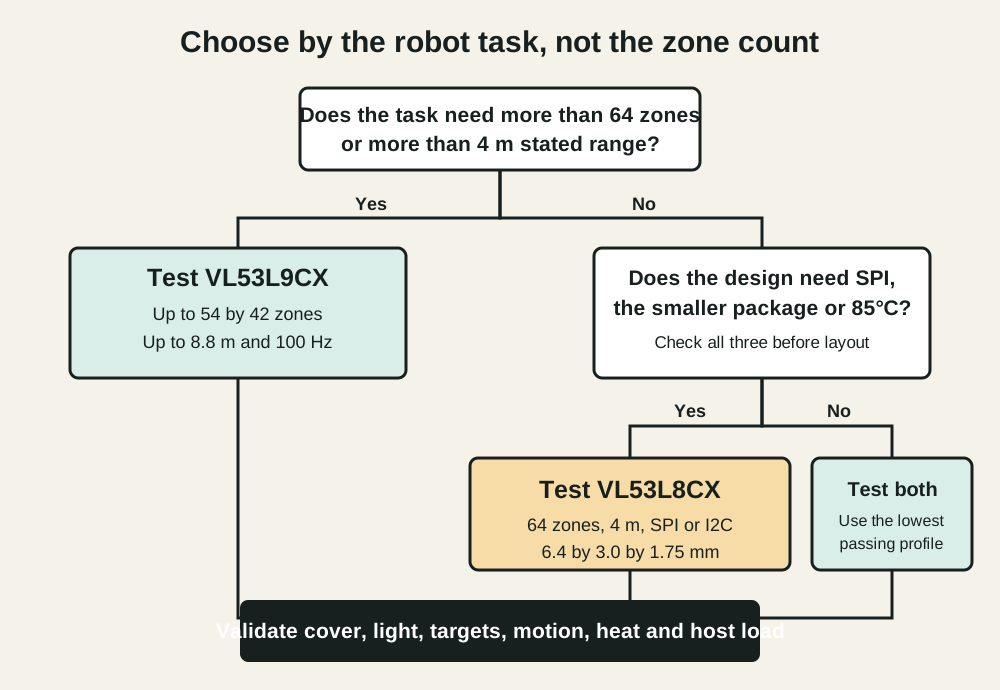
Choose the ST VL53L9CX when a robot needs enough depth detail to separate small objects or contours, needs more than 4 meters of specified range, or can use MIPI CSI-2 or I3C for a larger data stream. Choose the VL53L8CX when 64 zones and 4 meters cover the task, or when the design needs its smaller package, SPI interface or 85°C upper operating temperature.
Do not upgrade on zone count alone. ST's new VL53L9CX produces up to 54 by 42 zones, reaches up to 8.8 meters and can run at up to 100 Hz. The VL53L8CX produces 8 by 8 zones, reaches up to 4 meters and can run at up to 60 Hz.[1][3] Those limits describe different sensor configurations and test conditions. Your robot still needs a representative test with its cover, target surfaces, light and motion.
Which sensor fits which robot?
VL53L9CX fits a mobile robot that must separate edges, openings or small obstacles in one compact depth module. ST lists 2,268 zones, a 55° by 42° field of view and processed depth, infrared, reflectance and confidence outputs. Its MIPI CSI-2 or I3C paths suit hosts that can handle the larger output.[2]
VL53L8CX fits simpler presence, wall, floor and obstacle measurements where an 8 by 8 map gives enough spatial detail. ST lists robotics uses including SLAM, wall tracking, small object sensing, cliff prediction and floor recognition. That list describes intended uses, not a proven result on a particular robot.[3]
The practical split is data shape. An 8 by 8 map contains 64 distance zones. A 54 by 42 map contains 2,268. The larger map may expose features that disappear when one zone combines reflected signals from different surfaces. It also moves more data and asks more of the host. Measure whether the extra detail changes a navigation or obstacle decision before doing the extra work to integrate it.
| Decision factor | VL53L9CX | VL53L8CX | What it means for a robot |
|---|---|---|---|
| Maximum zone grid | 54 by 42, or 2,268 zones | 8 by 8, or 64 zones | L9 supplies a much denser depth map. Test whether the robot uses that detail. |
| Datasheet ranging span | 50 to 8,800 mm per zone | 20 to 4,000 mm per zone | L9 covers the longer stated span. Actual reach changes with mode, light and target. |
| Maximum sample rate | Up to 100 Hz | Up to 60 Hz | Neither maximum proves usable rate with the chosen output, exposure and host. |
| Field of view | 55° by 42°, 71° diagonal | 65° diagonal square field | Compare coverage at the intended mounting height and angle. |
| Main interfaces | MIPI CSI-2 output; I3C or I2C control and data | SPI or I2C | Start with an interface the host can sustain and route correctly. |
| Package size | 12.83 by 6.10 by 4.64 mm | 6.4 by 3.0 by 1.75 mm | L8 occupies less package volume. Optical keepouts and cover design still need review. |
| Operating temperature | -30°C to 70°C | -30°C to 85°C | L8 has the higher listed upper limit. Neither range proves the full robot will meet its environment rating. |
*Specifications: ST VL53L9CX and VL53L8CX datasheets, revisions dated July 2026 and July 2025, checked 2026-09-14.[2][4]*
When does the VL53L9CX earn the extra zones?
VL53L9CX earns its extra zones when a 64 zone map merges objects that the robot must treat differently. Put the smallest relevant obstacle beside the expected floor, wall or load edge, then record both raw maps and the downstream decision. If navigation or obstacle behavior does not improve, the denser map has not earned its place.
The L9 can return depth, actively illuminated infrared, ambient infrared, reflectance and confidence maps. Its full ranging output at 54 by 42 includes four arrays and occupies 14,742 bytes according to the datasheet. Smaller grids reduce that payload.[2] That is a host and memory question as much as a sensing benefit.
Frame rate needs the same discipline. The L9 datasheet says MIPI CSI-2 is the default output. Data can travel through I3C or I2C instead, but it warns that achievable frame rate falls with the chosen map size and interface. ST recommends an I3C host for increased bandwidth.[2]
A robot that already carries camera serial hardware may have a clean route for MIPI CSI-2. A small microcontroller design may not. Do the interface review before laying out the optical housing. If the host choice is still open, our Jetson Thor vs AGX Orin guide explains why workload, memory and power measurements should decide the compute board.
When is the VL53L8CX the better design?
VL53L8CX is the better starting point when a robot needs coarse free space, presence or cliff information within 4 meters. Its 6.4 by 3.0 by 1.75 mm package can settle the choice in a tight sensor head. It provides I2C up to 1 MHz or SPI up to 3 MHz, plus continuous or autonomous ranging.[4]
Low duty cycle sensing is another reason to test it. ST gives a typical 1.6 mW example for 4 by 4 autonomous ranging at 1 Hz with a 5 ms exposure. The same datasheet gives 215 mW as a continuous mode example.[4] These are profile examples, not a power guarantee for your robot. Measure the selected mode with the complete regulator and host awake behavior.
Temperature may rule out the L9 before image quality enters the discussion. ST lists -30°C to 85°C for VL53L8CX and -30°C to 70°C for VL53L9CX.[2][4] Use the sensor's local temperature in the proposed enclosure, not only the room temperature. The L9 datasheet warns that ranging noise and error increase as junction temperature rises and recommends distance from heat producing components.[2]
Why the headline range needs a test plan
ST specifies VL53L9CX from 50 mm to 8,800 mm per zone and VL53L8CX from 20 mm to 4,000 mm per zone.[2][4] Those maxima do not describe every target. Both datasheets vary results by reflectance, ambient light, zone location, grid size, frame rate and exposure, so a range claim needs a task specific test.
For example, the L8 datasheet's 4 by 4 continuous test at 30 Hz reports a typical 4,000 mm range on a white target in darkness. The typical inner zone result falls to 2,850 mm under 5 kilolux ambient light in that test setup.[4] One changed condition moves the published result. The test does not predict an outdoor robot under different light.
The L9 has separate precision and ambient modes and six listed grid choices. Its profile examples exchange range or rate for exposure and power. They do not maximize all four at once.[2] Set one pass case for each task:
1. Use the intended cover material and mechanical opening. 2. Test the darkest and brightest relevant targets at the needed angles. 3. Reproduce the lowest and highest expected ambient light. 4. Add robot and target motion at the required speed. 5. Record invalid zones, confidence, latency and power beside distance error. 6. Repeat after the enclosure reaches its steady operating temperature.
We recommend those engineering checks. We do not claim that either part will pass on a named robot or in a named environment.
How should a team run the comparison?
Run the VL53L9CX vs VL53L8CX comparison from a recorded task failure, not a headline datasheet number. Save the scene, object dimensions, surfaces, light level, mounting position, robot speed and decision deadline. Then collect data from both candidates without changing the pass rule, settings record or success margin between them.
Keep the first comparison narrow. If L8 detects the required obstacle with enough margin, test its smaller package and simpler host path in the robot. If it merges a task critical feature, repeat with L9 at the smallest grid and slowest rate that preserve the decision. That avoids designing around 2,268 zones when a smaller L9 mode would work.
ST announced the VL53L9 in June 2026 and said volume shipments would start in early July. The current product page marks VL53L9CX active and available in volume.[5][1] Availability status still does not guarantee supply at the quantity, location or date a project needs. Obtain a current quote and lead time before freezing the design.
The decision record should preserve the sensor order code, datasheet revision, settings, firmware or driver revision, board revision, cover material and test data. Both datasheets can change. The L9 document reached revision 7 in July 2026 after its first public release in May.[2]
VL53L9CX vs VL53L8CX: the verdict
VL53L9CX is the better candidate when a task proves it needs finer depth structure, more than 4 meters of stated range or faster full frame sensing. Its extra capability comes with a larger package, a lower upper operating temperature and a more demanding data path, so the test result must justify the work to integrate it.
VL53L8CX remains the sensible default for coarse short range robotics sensing. Its 64 zones, smaller body, SPI option and 85°C upper rating can be advantages, not compromises, when they match the task. Build the smallest test that can show whether 64 zones lose information the robot needs. Let that result choose the sensor.
VL53L9CX vs VL53L8CX questions
What zone counts do VL53L9CX and VL53L8CX provide?
VL53L9CX provides up to 54 by 42 zones, or 2,268. VL53L8CX provides up to 8 by 8 zones, or 64.
Which sensor has the longer specified range?
ST lists VL53L9CX from 50 mm to 8,800 mm per zone and VL53L8CX from 20 mm to 4,000 mm per zone. Target, light, mode and exposure affect usable range.
Can VL53L9CX use I2C?
Yes. Its datasheet allows control and data over I2C, but says the achievable frame rate falls depending on the chosen map size and interface. MIPI CSI-2 is the default output, and ST recommends I3C when using the control interface for more bandwidth.
Which part is smaller?
VL53L8CX is smaller at 6.4 by 3.0 by 1.75 mm. VL53L9CX measures 12.83 by 6.10 by 4.64 mm.
Does Class 1 make either sensor enough for robot safety?
No. The label concerns the laser product. The finished robot still needs a safety review and application level measures.
Sources
- https://www.st.com/en/imaging-and-photonics-solutions/vl53l9cx.html
- https://www.st.com/resource/en/datasheet/vl53l9cx.pdf
- https://www.st.com/en/imaging-and-photonics-solutions/vl53l8cx.html
- https://www.st.com/resource/en/datasheet/vl53l8cx.pdf
- https://newsroom.st.com/media-center/press-item.html/p4783.html