Canadarm2 Cygnus Release: How It Works
Canadarm2 released Cygnus XL from the ISS on October 9. The cargo arm unberths the spacecraft, moves it clear, then releases it for departure.
Canadarm2 released Northrop Grumman's Cygnus XL from the International Space Station on October 9, after ground controllers detached the cargo spacecraft from Unity's Earth-facing port and moved it into position. NASA reported the release at 12:44 p.m. EDT, about six months after Cygnus XL arrived.[1]
A Canadarm2 Cygnus release is a controlled reversal of the arrival process. The arm does not fly the cargo craft away. It unberths the vehicle, carries it to a clear release point, and lets it go. Cygnus then departs under its own control. The arm berths Cygnus to the station instead of letting the spacecraft dock itself.[2][3]
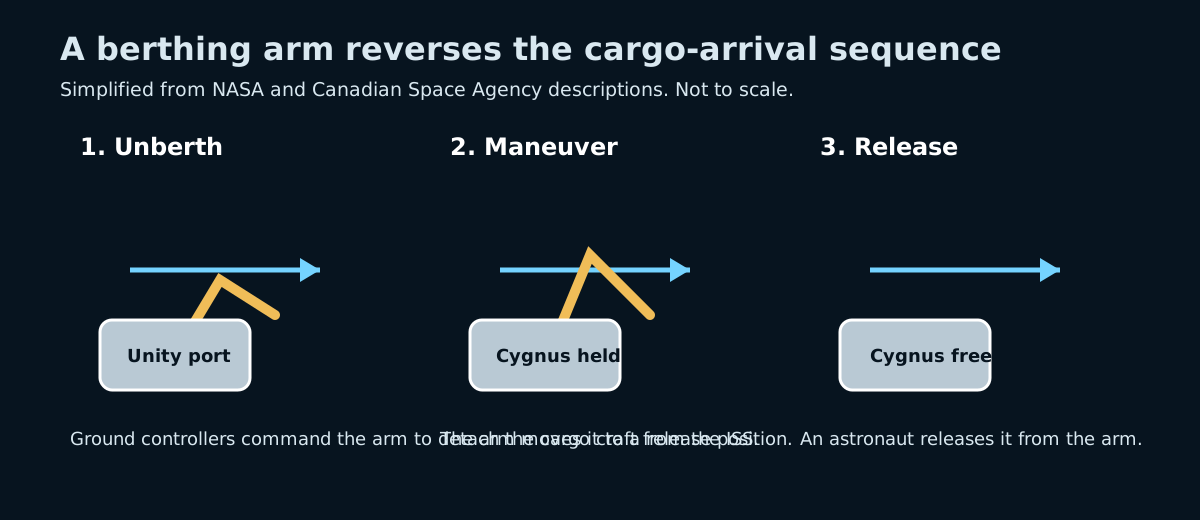
What happens during a Canadarm2 Cygnus release?
A Canadarm2 Cygnus release has three practical stages: detach the spacecraft from its station port, maneuver it to a release position, then open the arm's grip. NASA described that exact sequence for Cygnus XL: controllers detached it from Unity, moved it into place, and an astronaut monitored the release.[1]
Spaceflight teams call this unberthing, not undocking. A docking spacecraft joins the station through its own final approach. Cygnus instead reaches a capture point, then Canadarm2 grapples it and controllers berth it to a port. The same hardware reverses the connection at the end of the cargo mission.[2][3]
The distinction is not wordplay. It tells you where responsibility changes hands. The arm and station team handle the physical path near the ISS. Once free, Cygnus uses its own propulsion and flight system for the departure and later deorbit.
How does Canadarm2 hold and move cargo?
Canadarm2 has a Latching End Effector at each end. The Canadian Space Agency describes these as identical hands with cables that tighten around an object or let the arm anchor itself to the station. Either end can become the anchor while the other works.[5]
The arm is 17 meters long, has seven degrees of freedom, and has three shoulder joints, one elbow joint, and three wrist joints. Those joints give a long structure enough articulation to position a spacecraft without treating it like a simple crane.[4]
Show data
| Shoulder joints | 3 |
|---|---|
| Elbow joint | 1 |
| Wrist joints | 3 |
The arm can also move around the station. It uses one end as an anchor point, then can walk end-over-end between power and data grapple fixtures. That mobility is why the same system supports cargo, maintenance, external equipment, and astronauts during spacewalk operations.[5]
Who operates the arm during cargo work?
A Canadarm2 Cygnus release combines onboard and ground roles. The Canadian Space Agency says its Robotics Mission Control Centre plans, monitors, and controls most Canadarm2 operations, while the ISS crew takes time-critical control for tasks such as capturing cargo vehicles.[6]
For Cygnus XL's October departure, NASA identified ground controllers as the team that commanded the unberthing and maneuver. It also named an astronaut as the monitor for the release.[1] The public updates do not disclose every control handoff or the full departure timeline, so they do not support a claim that one operator alone performed the whole sequence.
For a useful distinction between a robot's physical capability and its assigned job, see our explainer on the Arm Robotics Capability Framework. For a broader vocabulary check, read what counts as a service robot.
What happens after Cygnus is released?
After release, the cargo spacecraft leaves the station's vicinity and prepares for disposal. NASA scheduled Cygnus XL's October 12 deorbit with thousands of pounds of disposal items, followed by a destructive atmospheric re-entry.[1]
That end-of-mission role is part of the system's design, not a malfunction. Cargo that does not need to return to Earth can leave the station aboard a disposable spacecraft. By contrast, the robotic arm remains on the station for the next external task.
- 2001-04-19Canadarm2 launched to the International Space Station.[4]
- 2025-09-18Canadarm2 captured Cygnus XL and maneuvered it toward Unity for installation.[2]
- 2026-10-09Canadarm2 detached, maneuvered, and released Cygnus XL from the ISS.[1]
- 2026-10-12NASA scheduled Cygnus XL's deorbit with disposal cargo.[1]
Canadarm2 Cygnus release questions
Did Canadarm2 push Cygnus XL away from the ISS?
No. The arm detached Cygnus XL from Unity, maneuvered it to a release position, and released it. The spacecraft then conducted its own departure operations.[1]
Why does Cygnus need Canadarm2?
Cygnus is an arm-berthed cargo spacecraft. Canadarm2 grapples it at arrival and controllers berth it to the station, so the arm also reverses that process before departure.[2][3]
How long is Canadarm2?
Canadarm2 is 17 meters long and has seven degrees of freedom, according to the Canadian Space Agency.[4]
What happens to Cygnus after it leaves the ISS?
NASA said Cygnus XL would carry disposal cargo into a planned destructive re-entry, where it would burn up in the atmosphere.[1]
Sources
- https://www.nasa.gov/blogs/spacestation/2026/10/09/cygnus-xl-cargo-spacecraft-released-from-station-by-canadarm2
- https://www.nasa.gov/blogs/spacestation/2025/09/18/robotic-arm-maneuvering-cygnus-for-station-installation/
- https://www.asc-csa.gc.ca/eng/iss/canadarm2/cosmic-catches.asp
- https://www.asc-csa.gc.ca/eng/iss/canadarm2/data-sheet.asp
- https://www.asc-csa.gc.ca/eng/iss/canadarm2/about.asp
- https://www.asc-csa.gc.ca/eng/iss/robotics/robotics-mission-control-centre.asp