What Is a Service Robot? IFR Categories Explained
ISO defines the vocabulary. IFR adds reporting rules that decide whether an AMR, surgical system or powered device appears in service robot statistics.
What is a service robot? It performs useful tasks for people or equipment. ISO 8373:2021 supplies that compact definition, and it covers a delivery robot in a hospital, a floor scrubber in a station and a robot mower at home. It does not settle every statistical boundary.[3]
The International Federation of Robotics, or IFR, adds reporting rules for its annual World Robotics data. Those rules separate consumer, professional and medical machines, and they also admit some robotic devices that do not meet the ISO definition of a robot.[3] This matters whenever an IFR report says service robot sales rose or one application outsold another. Before comparing the numbers, check what IFR counted.
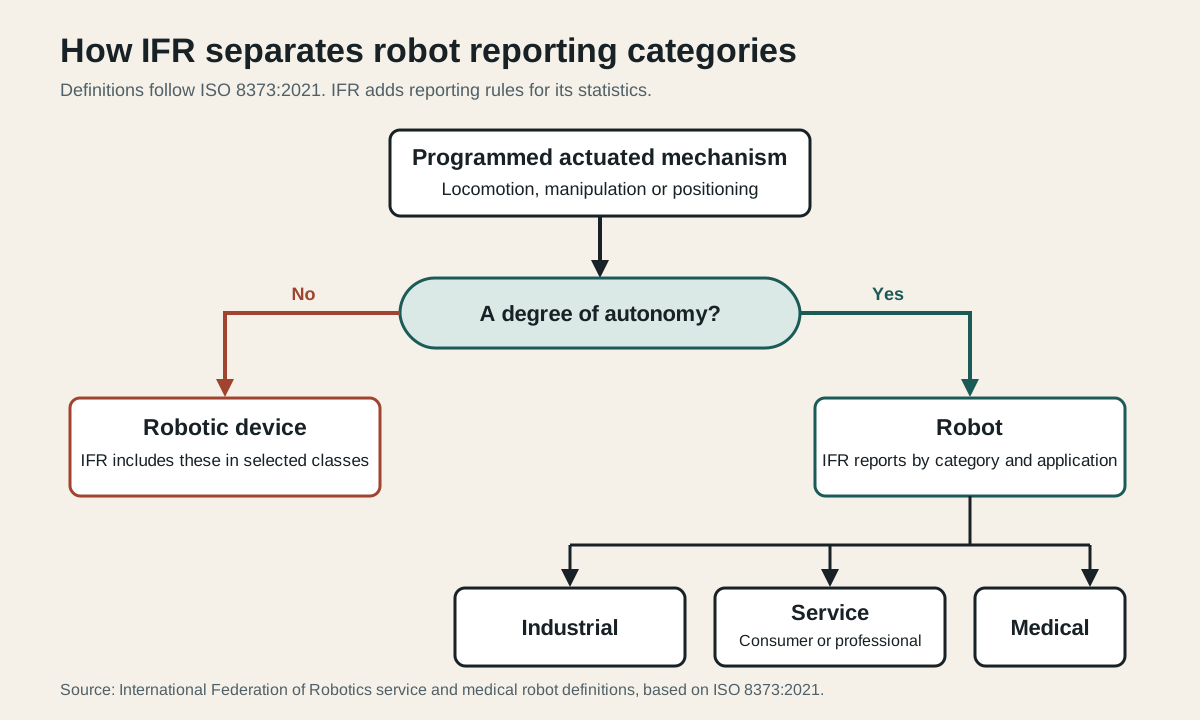
What makes a mechanism a robot?
ISO 8373:2021 starts with a mechanism, not a product label: a controller must program and actuate it, and it must possess a degree of autonomy and perform locomotion, manipulation or positioning.[3] Autonomy is the dividing line for borderline machines. IFR quotes the ISO concept as the ability to perform intended tasks from the current state and sensing without human intervention, so a teleoperated manipulator can use robot technology without qualifying as a robot. ISO calls that a robotic device, a distinction narrower than everyday speech.
A vendor may still sell a remotely controlled bomb disposal machine or powered rehabilitation system as a robot. IFR includes such devices in selected data classes, but it records that choice as a departure from counting robots alone.[3] Robot technology is not enough on its own: a sensor, gripper or unpowered exoskeleton can belong in a robotic system without becoming a robot under the vocabulary.
A product name can say "robot" while the statistical method says "robotic device." The test is autonomy and function, not the badge on the casing.
How does IFR split service robots?
ISO 8373:2021 distinguishes personal and professional service robots but does not define those two terms in detail. IFR instead uses consumer and professional categories based on training.[3]
A consumer service robot needs no professional training for setup or safe use; IFR examples include domestic cleaning robots, automated wheelchairs and social interaction robots. A professional service robot requires a trained operator, though occupational safety instruction can satisfy that test instead of a robotics qualification. Public space cleaning robots, delivery robots and firefighting robots fall on this side of the split.
The task alone does not decide the category. Cleaning appears in homes and public buildings, and the same overlap applies to guiding people, handling food and moving items. Whether the operator needs training is the cleaner test.
| IFR category | Practical test | Examples in IFR methodology | Important qualification |
|---|---|---|---|
| Consumer service robot | A layperson can set up and operate it safely without professional training | Domestic floor cleaning, gardening, social interaction | Care at home can include robotic devices. |
| Professional service robot | A trained professional operates it | Logistics, public space cleaning, agriculture, inspection | Search, rescue and security can include robotic devices. |
| Medical robot | It is intended for use as medical electrical equipment | Diagnostics, surgery, rehabilitation, laboratory analysis | Several medical classes include robotic devices. |
The table describes IFR reporting categories. It is not a safety certification or a claim that every product in an application has the same risk.
Why is a medical robot separate?
ISO 8373:2021 defines a medical robot as one intended for use as medical electrical equipment, and IFR now treats medical robots as a third category beside industrial and service robots.[3] The World Robotics service volume still carries the medical data for practical reasons: the statistical codes preserve some history. Medical robotics used to sit inside professional service robots as application group AP6, and starting with World Robotics 2024, IFR promoted it to a category of its own but retained the AP6 label.
IFR also includes robotic devices in diagnostics, surgery, rehabilitation and noninvasive therapy, while laboratory analysis robots and other medical robots must have enough autonomy to qualify as robots. This means a total labeled "service and medical robotics" can be broader than the ISO service robot category, so keep medical figures separate unless the report explicitly combines them.
Is an AMR always a service robot?
"Autonomous mobile robot," or AMR, is a market term absent from ISO 8373:2021. IFR applies it to wheeled mobile robots used in professional applications and classifies those machines as service robots.[3] An automated guided vehicle follows a predetermined path marked by an external guide, and IFR's reading of ISO 8373 classifies an AGV as a robotic device because it cannot determine its own path or navigate without that guide.
A mobile manipulator creates another boundary. When an AMR carries an articulated robot arm, IFR can count the manipulator as an industrial robot and the mobile platform as a service robot. The acronym therefore cannot carry the classification by itself. Ask what moves, what manipulates, how the system chooses a path and which unit the report counts.
Can one machine appear in two IFR datasets?
Yes. IFR puts robots with common industrial kinematics in both datasets when they work in service or medical applications, and since 2024 the industrial series places those cases in class 904 for service applications and class 905 for medical applications.[3] This reporting overlap does not represent two physical units, so adding an industrial total to a service total can double count machines covered by that rule.
The categories also differ in scope. IFR industrial robot statistics count robots, while its service and medical statistics include robotic devices in selected application classes such as search and rescue, care at home, diagnostics, surgery and rehabilitation.
Our reading: compare rows within one IFR table before attempting to combine totals from separate books. If a combined figure is necessary, the methodology must explain how it removes overlaps.
What did IFR's 2024 sample measure?
IFR reported that professional service robot sales grew 9% in 2024, medical robot sales grew 91%, and consumer service robot sales grew 11%, from a sample of 294 service robot suppliers.[5]
Show data
| Professional service robots | 9 |
|---|---|
| Medical robots | 91 |
| Consumer service robots | 11 |
The medical bar is much taller, but it does not show the largest market by unit volume. In the same 2024 sample IFR recorded close to 16,700 medical robots, more than 199,000 professional service robots and close to 20 million consumer service robots.[5]
IFR says the service robot figures are sample data, not a projection of the whole industry, and the sample changes between annual editions. IFR therefore advises readers not to compile or compare numbers from different World Robotics reports. That warning rules out a tempting shortcut: a year-over-year percentage printed in one edition follows IFR's method for that release, and a reader should not reconstruct a trend by lifting totals from separate editions and treating the samples as fixed.
How are the definitions changing in 2026?
ISO 8373:2021 remains the published third edition of the robotics vocabulary. ISO lists it as due for revision and expects the draft to replace it within months.[1] ISO is still developing the proposed fourth edition, ISO/DIS 8373, which reached stage 40.60 after the draft ballot closed on May 1, 2026.[2] The standard has not reached the final text or publication stages, so the draft does not replace the 2021 edition.
- 2021-11: ISO publishes the third edition of ISO 8373, Robotics vocabulary.
- 2024: IFR begins treating medical robots as a separate statistical category and starts reporting service and medical applications with industrial kinematics in dedicated industrial classes.
- 2026-05: Voting closes on the fourth edition draft, ISO/DIS 8373.
- 2026-09: IFR schedules World Robotics 2026 for publication on September 24.
The timeline holds two different processes. ISO owns the vocabulary standard; IFR owns the methodology for its market statistics. A revised ISO vocabulary can influence later IFR categories, but a draft does not replace the published 2021 edition.
How should you read a service robot number?
Start with the edition and reporting year. World Robotics 2025 reports 2024 sales, and IFR plans to publish the World Robotics 2026 books on September 24, 2026.[4] Then check five points:
1. Does the figure cover consumer, professional or medical machines? 2. Is it counting sales, installations, an operating fleet or suppliers? 3. Does the class include robotic devices as well as robots? 4. Could a mobile manipulator or industrial-style arm appear in another IFR dataset? 5. Is the number from one annual sample, or has someone combined editions despite IFR's warning?
A service robot total can differ from casual usage because IFR defines its reporting boundary, and it becomes misleading when the boundary disappears from the retelling. For the 2026 report cycle, use the precise IFR label: "professional service robots reported by IFR suppliers" says more than "robots sold worldwide," because it identifies the category, the source and the sample behind the claim.
Service robot definitions
Is every autonomous machine a robot?
No. Under ISO 8373:2021, a robot is a programmed and actuated mechanism with a degree of autonomy that performs locomotion, manipulation or positioning.
Is a robot vacuum a service robot?
IFR classifies domestic floor cleaning machines that meet the robot definition as consumer service robots.
Is an AMR an industrial robot?
IFR classifies a wheeled AMR as a professional service robot. If it carries an articulated arm, IFR can count the arm as an industrial robot and the platform as a service robot.
Are surgical systems included in service robot data?
IFR reports medical robotics separately but publishes the data in its World Robotics service volume. Its surgery class can include robotic devices.
Sources
- https://www.iso.org/standard/75539.html
- https://iso.org/standard/90762.html
- https://ifr.org/img/worldrobotics/Definition_Service_Robots_2026.pdf
- https://ifr.org/worldrobotics/
- https://ifr.org/ifr-press-releases/news/service-robots-see-global-growth-boom