Robot Mower Slope Ratings: What 80% Means
An 80% robot mower slope rating equals about 38.7 degrees. Here is how to read grade claims and measure the hill before buying.
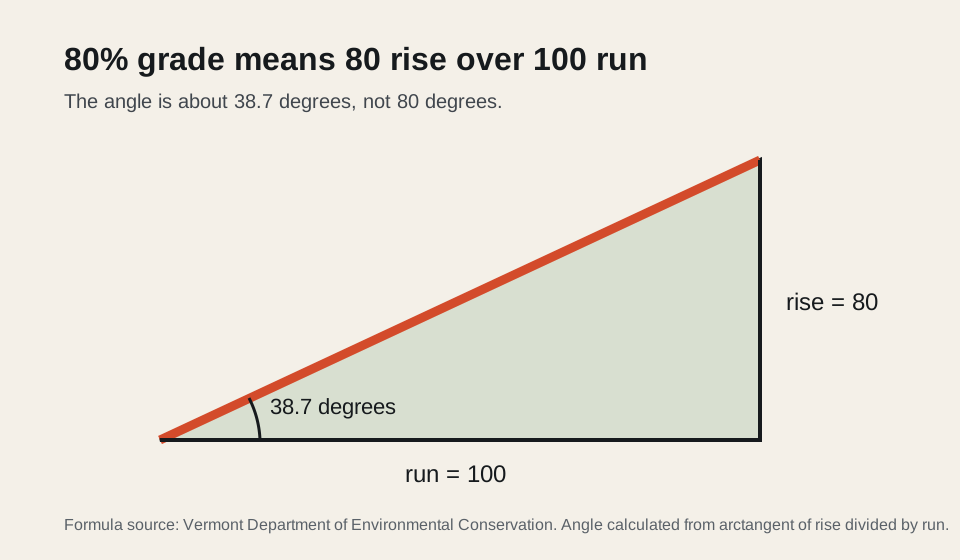
A robot mower slope rating of 80% means the ground rises 80 units for every 100 units of horizontal distance. It does not mean an 80 degree hill. The equivalent angle is about 38.7 degrees.
Steep slope claims have become a visible contest among all wheel drive robot mowers. Husqvarna rated its 2019 Automower 435X AWD for 70%.[2] Mammotion later advertised 80% for LUBA 2 AWD.[3]
At IFA 2026, Sunseeker announced 80% for its S7 LiDAR Ultra AWD 3000.[5] AIRSEEKERS claimed 85% for ARANIX.[4]
Those are manufacturer ratings, not results from one common independent test. Use them to screen products. Do not treat a five point lead as proof that one mower will handle your lawn better.
How do robot mower slope percentages convert to degrees?
Robot mower slope percentages and degrees describe the same incline on different scales. Percent is rise divided by horizontal run, multiplied by 100; degrees measure the angle from horizontal. An 80% grade is about 38.7 degrees, while a 100% grade is 45 degrees. Convert the figures before comparing them.[1]
Convert the grade to an angle with the arctangent of rise divided by run. On that basis, 70% is about 35.0 degrees, 80% is about 38.7 degrees, and 85% is about 40.4 degrees. The gap between the last two claims is about 1.7 degrees, even though the labels differ by five percentage points.
| Advertised grade | Approximate angle | Rise over 100 units of horizontal run |
|---|---|---|
| 70% | 35.0 degrees | 70 units |
| 80% | 38.7 degrees | 80 units |
| 85% | 40.4 degrees | 85 units |
| 100% | 45.0 degrees | 100 units |
The calculations above apply the Vermont formula.[1] They clarify the geometry only. They do not predict traction, stopping distance, cutting quality or whether a mower can turn on the slope.
A higher slope number describes a steeper claimed limit. It does not describe how the mower behaves at that limit.
What does AWD change on a steep slope?
AWD gives all four wheels drive torque, but it does not guarantee grip, clean turns or a reliable route home. Chassis articulation, wheel contact and surface conditions still matter. Husqvarna, Mammotion, Sunseeker and AIRSEEKERS pair steep slope claims with different mechanical and navigation systems, so their headline percentages are not directly comparable.[2][3][4][5]
The four products make different engineering claims. Husqvarna says the 435X AWD uses two connected body sections and all wheel drive to climb slopes up to 70%.[2]
Mammotion links LUBA 2 AWD's 80% claim to its all wheel drive chassis.[3] AIRSEEKERS says each ARANIX wheel has separate drive and steering control. The layout permits sideways movement and zero radius turns. AIRSEEKERS rates the mower for 85%, or 40 degrees.[4]
Sunseeker says its S7 combines all wheel drive with 360 degree LiDAR.[5] It rates the mower for slopes up to 80%, or about 39 degrees.[5]
LiDAR can help a mower map and locate obstacles. It cannot create tire grip. Buyers need to separate navigation features from the mechanical slope claim.
The shape of a real lawn adds variables that a headline number cannot capture. A slope may have wet grass, exposed soil, roots, a crest or a drop at the boundary. Husqvarna, Mammotion and AIRSEEKERS do not provide a shared test course in the cited material.[2][3][4] Sunseeker does not add a common test account.[5]
Which robot mowers claim 70%, 80% and 85% slopes?
Selected AWD robot mower claims now span 70% to 85%, which converts to roughly 35.0 to 40.4 degrees. Husqvarna claims 70% for Automower 435X AWD, Mammotion and Sunseeker claim 80%, and AIRSEEKERS claims 85%. These are manufacturer limits, not results from one independent course.[1][2][3][4][5]
Show data
| Husqvarna 435X AWD | 70 |
|---|---|
| Mammotion LUBA 2 AWD | 80 |
| Sunseeker S7 AWD | 80 |
| AIRSEEKERS ARANIX | 85 |
The chart compares advertised maximum grades, not independent tests. Husqvarna's 70% claim converts to about 35.0 degrees.[1][2] The 80% claims from Mammotion and Sunseeker convert to about 38.7 degrees.[1][3][5] AIRSEEKERS pairs its 85% figure with 40 degrees. The formula gives about 40.4 degrees before rounding.[1][4]
A mower may reach its limit in a controlled test yet fail to suit a particular lawn. It still has to cut, turn, cross the crest and return to its charger. The cited vendor material does not establish those outcomes on a common course.
How did robot mower slope ratings rise from 70% to 85%?
Husqvarna advertised a 70% AWD robot mower limit in 2019, while AIRSEEKERS advertised 85% in 2026. That seven year change is a shift in claimed maximum grade, not proof of better mowing on the same hill. The cited manufacturers do not publish results from a shared test course.[2][3][4][5]
- 2019-02: Husqvarna launches Automower 435X AWD with a claimed 70% maximum incline.[2]
- 2024-01: Mammotion launches the LUBA 2 AWD series and associates it with an 80% slope claim.[3]
- 2026-09: Sunseeker announces the S7 LiDAR Ultra AWD 3000 at IFA with an 80% rating and February 2027 availability.[5]
- 2026-09: AIRSEEKERS debuts ARANIX at IFA with an 85%, or 40 degree, rating.[4]
The timeline shows a seven year increase in advertised limits. It does not establish better results on a fixed test. The cited Husqvarna, Mammotion and AIRSEEKERS material describes different machines without a common test.[2][3][4] Sunseeker does not supply that test either.[5]
How do you measure lawn slope for a robot mower?
Measure the steepest part of every route the robot mower must use, not the garden's average slope. Hold a straight board level along the direction of travel, measure the vertical rise and horizontal run, then divide rise by run and multiply by 100. Repeat this check near turns, boundaries and the charging route.[1]
For a mower purchase, keep the measurements separate as well as noting any average. A short sharp section can exceed a product limit even when the wider bank looks moderate.
1. Place a straight board in the direction of the slope. 2. Raise the lower end until the board is level. 3. Measure the vertical gap under that end. This is the rise. 4. Measure the board's horizontal length. This is the run. 5. Divide rise by run and multiply by 100.[1]
Use the same unit for both measurements. A 40 centimeter rise under a 100 centimeter level board is a 40% grade. Repeat the check near boundaries, turns, narrow passages and the route to the charging station.
What does a robot mower slope rating leave unanswered?
A robot mower slope rating states the maximum incline its manufacturer claims, but it does not tell you how the mower will perform on your lawn. The figure leaves grip, turning, cutting, braking and boundary behavior unresolved unless the manufacturer publishes the test conditions.[2][3][4][5]
Compare your measurements with the manual and ask how the warranty treats your terrain.
The buyer's useful comparison is therefore wider than one percentage. Record the steepest rise and run, inspect the route and ask for the relevant manual limits at boundaries and obstacles. Then check whether the seller's return policy or an on site test covers the actual hill.
For the latest 80% and 85% machines, the evidence is still vendor supplied.[3][4][5] That is enough to explain what the numbers mean. It is not enough to declare a winner.
Robotsider applies the same source discipline when product claims run ahead of independent testing. Our Unitree H2 Plus review and Microduck review separate published specifications and vendor demonstrations from tested outcomes.
Robot mower slope ratings: common questions
Is an 80% slope the same as 80 degrees?
No. An 80% grade rises 80 units over 100 units of horizontal run. Its angle is about 38.7 degrees.[1]
What angle is a 70% robot mower slope rating?
A 70% grade is about 35.0 degrees when calculated from rise divided by horizontal run.[1]
Does AWD guarantee a robot mower will handle a steep lawn?
No. AWD is one part of the chassis. The maximum rating does not establish how the mower will turn, cut or charge on a specific wet, uneven or obstructed lawn.
How should I measure lawn slope?
Measure vertical rise over a level horizontal run, divide rise by run, then multiply by 100. Repeat the process across the sections the mower must use.[1]
Sources
[1] Vermont Department of Environmental Conservation, "Determining the Slope of Your Shoreland." https://dec.vermont.gov/sites/dec/files/wsm/lakes/docs/Shoreland/lp_AppendixBSlopeGuidance.pdf
[2] Husqvarna Group, "Husqvarna launches AI enabled robotic mower with AWD," February 25, 2019. https://www.husqvarnagroup.com/en/news/husqvarna-launches-ai-enabled-robotic-mower-awd
[3] Mammotion, "About Mammotion," company milestone page, accessed September 11, 2026. https://us.mammotion.com/pages/about-us
[4] AIRSEEKERS, "AIRSEEKERS ARANIX Robot Lawn Mower Debuts at IFA 2026," September 10, 2026. https://eu.airseekers-robotics.com/en-de/blogs/news/airseekers-aranix-robot-lawn-mower-debuts-at-ifa-2026
[5] Sunseeker Robotics, "IFA 2026: Sunseeker Debuts 2027 LiDAR Models, Smart Garden Ecosystem and Industry First 3D Semantic Map," September 4, 2026. https://www.prnewswire.com/news-releases/ifa-2026-sunseeker-debuts-2027-lidar-models-smart-garden-ecosystem-and-industryfirst-3d-semantic-map-302870158.html
Sources
- https://dec.vermont.gov/sites/dec/files/wsm/lakes/docs/Shoreland/lp_AppendixBSlopeGuidance.pdf
- https://www.husqvarnagroup.com/en/news/husqvarna-launches-ai-enabled-robotic-mower-awd
- https://us.mammotion.com/pages/about-us
- https://eu.airseekers-robotics.com/en-de/blogs/news/airseekers-aranix-robot-lawn-mower-debuts-at-ifa-2026
- https://www.prnewswire.com/news-releases/ifa-2026-sunseeker-debuts-2027-lidar-models-smart-garden-ecosystem-and-industryfirst-3d-semantic-map-302870158.html