Digit 5 Safety: What the Offboard Bridge Adds
Digit 5 safety now includes an offboard bridge for external systems. It adds a layer, but it does not replace a site-specific safety case.
Digit 5 safety now has a proposed facility-side layer. Agility Robotics and FORT Robotics announced an offboard safety bridge on October 1, alongside a pendant and on-robot communications. It adds an architectural layer, but it is not a published approval for Digit 5 to work unguarded in every warehouse.[1]
The point is easy to miss in the headline. A humanoid can be stable, detect a person and stop under a planned condition, yet still be a poor fit for a particular aisle, payload, crossing route or recovery task. The safety case belongs to the complete application.
What is the Digit 5 offboard safety bridge?
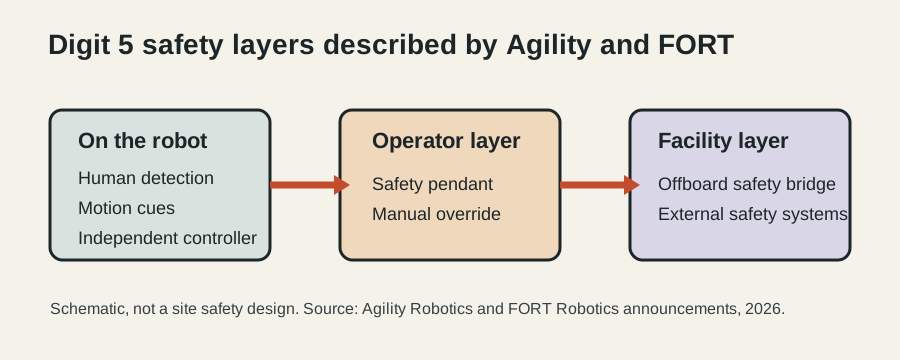
The Digit 5 offboard safety bridge is a jointly described interface that connects the robot with external safety systems. It sits outside the robot, while Agility's planned Digit 5 architecture also includes person detection, motion cues and an independent safety controller.[1][2]
Agility and FORT say their relationship began with a custom hardware component and has expanded into three parts: a safety pendant, on-robot communications and off-robot interfaces. The companies say the interface should extend the cooperative-safety approach beyond Digit itself.[1]
The announcement does not identify external devices, zones or interlocks. It also gives no response time, performance level, stopping distance or approved use case. Those omissions do not mean the bridge is ineffective. They mean a buyer cannot infer those values from this announcement.
The split between onboard and offboard logic matters. A robot needs its own response when it detects a nearby person or loses a critical signal. A facility may also need an external safety system to account for a shared aisle, a conveyor handoff, a gated area or another machine. Connecting the two can make a wider system easier to define. It does not eliminate the need to define it.
How does the operator pendant fit in?
The operator pendant is a manual layer that Agility and FORT say will provide emergency-stop and enabling-device functions. Operators can use it for monitoring, setup, maintenance and unexpected situations, while Digit 5 continues autonomous operation during normal work.[1]
A manual control layer answers a different question from automatic person detection. It gives an authorized worker a way to intervene. It does not prove that the robot can perceive every relevant person or hazard by itself.
Agility's public Digit 5 release describes three planned onboard elements: safe human detection, visual and auditory safety cues, and safe motion control by an independent safety controller. It says the detection function can cause the robot to avoid, stop or assume a seated position when a person is too close.[2]
Why does a facility-side link matter for humanoids?
A facility-side link matters because a mobile, balancing robot works inside a larger operating system. The route, load, handoff equipment and people on the floor can create hazards that are not visible in a product brochure.
Agility says its earlier Digits used a remote E-stop and later an external safety controller. It then added an onboard safety PLC because an external controller alone created a risk if communications with the robot failed. The company says its deployed humanoids operate behind physical workcell barriers because the earlier combination did not by itself establish safe proximity to people.[3]
That history is more useful than a broad claim that a robot is safe. It explains why redundancy and system boundaries matter. The offboard bridge adds a route for safety information from the environment. The onboard controller still needs to behave predictably if that route fails.
The bridge can connect a humanoid to a safety system. It cannot turn an untested workflow into a safe one.
What remains unproven after the announcement?
The partnership announcement names an architecture and future collaboration. It does not publish the evidence an operator would need to approve a specific Digit 5 job: test coverage, sensor blind spots, response timing, protective separation, fault behavior or limits for a chosen load and end effector.[1]
Agility expects Digit 5 early access in the first half of 2027 and general availability by the end of 2027. Those dates are company expectations, not proof of performance in an individual facility.[2]
The company also says it contributes to ANSI/A3 TR R15.108 and ISO 25785-1, both aimed at dynamically stable industrial mobile robots including humanoids. Draft standards work does not equal an application-specific finding.[2][3]
Show data
| Digit operational hours | 65000 |
|---|
Agility's reported operating history can guide questions for a pilot, but it cannot supply the denominator for a new workflow. Ask for records tied to the exact hardware, software, sensors, speed, load, end effector and operating environment under review.
What should a Digit 5 buyer test first?
A buyer should begin with one bounded workflow and make the pass conditions explicit. Map the route, the permitted load, the people who can enter the area, every handoff, each external safety device and every mode that permits motion.
Then test ordinary disruption: a blocked route, a changed load position, an entering worker, a dropped item, a sensor problem, loss of a required connection and a pendant activation. For each test, record the robot configuration, the expected response, the observed response and the restart authority.
The Digit 5 warehouse safety buyer guide provides a longer pilot checklist. For wider context on what present warehouse humanoids actually do, read our humanoid robots in warehouses explainer. Teams building a cell around a robot arm can also use our cobot safety standards buyer guide.
Our view: the useful signal in this announcement is not that Digit 5 has a new safety label. It is that Agility and FORT are making the facility boundary part of the design conversation. That is where real deployments succeed or fail. The next evidence worth watching is task-level validation that names the conditions and limits.
Digit 5 safety and the offboard bridge
What is Digit 5's offboard safety bridge?
Agility and FORT describe it as an interface that connects Digit 5 with external safety systems. It forms one part of an announced safety arrangement with a pendant and on-robot communications.
Does the offboard bridge mean Digit 5 can work without barriers?
No. The announcement describes planned architecture. It does not provide a blanket approval to change safeguards in a particular facility. The full robot application needs a site-specific safety assessment.
What are the three Digit 5 safety layers named by Agility and FORT?
The October 1 announcement names a safety pendant, on-robot communications and off-robot interfaces. Agility separately describes planned human detection, safety cues and an independent safety controller.
When will Digit 5 be available?
Agility says early access is expected in the first half of 2027 and general availability is expected by the end of 2027. Those dates are company expectations.
Sources
- https://www.agilityrobotics.com/content/agility-and-fort-robotics-announce-strategic-partnership-to-advance-humanoid-robot-safety
- https://www.agilityrobotics.com/content/agility-unveils-digit-5-humanoid-robot-built-for-cooperatively-safe-work-at-scale
- https://www.agilityrobotics.com/content/built-for-the-real-world
- https://www.fortrobotics.com/news/agility-and-fort-robotics-announce-strategic-partnership-to-advance-humanoid-robot-safety