Kawasaki CP110L Palletizer: What 2,200 Cases Means
Kawasaki's CP110L comes to PACK EXPO with a 110 kg payload and a 2,200-case-per-hour claim. Here is what that test figure does and does not say.
The Kawasaki CP110L palletizer is on show at PACK EXPO International in Chicago, which runs October 18-21. It is a floor-mounted, four-axis robot designed to lift cases at the end of a packaging line and stack them on pallets. Kawasaki rates it for a 110 kg payload, 2,505 mm maximum reach, and up to 2,200 cases an hour under one specified motion pattern.[1]
That last figure is useful, but it is not a promised line rate. It comes from a defined test: a 60 kg load including the end effector, moved 400 mm up, 2,000 mm horizontally, then 400 mm down and back. A real cell also waits for cases, changes patterns, handles gaps and may need people on the line. Kawasaki has not published a price for the CP110L.[2]
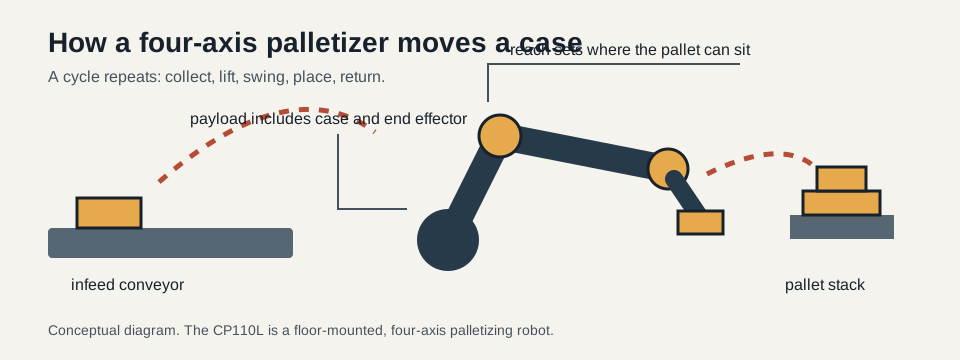
What is the Kawasaki CP110L palletizer?
The Kawasaki CP110L palletizer is a robot for repetitive end-of-line stacking. A conveyor presents a carton or case, the robot grips it with a customer-selected end effector, then places it at a programmed position in a pallet pattern. It does not decide whether a case is sound, choose a mixed order, or fix a jam unless the wider system provides those functions.
Kawasaki says the CP110L joins a CP-series range that now spans 110 kg to 700 kg payloads. It has a 2,505 mm maximum reach and four controlled axes. Kawasaki also lists plus or minus 0.05 mm repeatability and an 820 kg robot mass.[1] Those are machine facts, not a complete cell design. The gripper, guarding, infeed, pallet dispenser and controls can constrain the finished system.
How should buyers read the 2,200-case claim?
Kawasaki states that the CP110L can move up to 2,200 cases per hour under specified operating conditions. The company's February launch release defines those conditions as a 60 kg load including the hand and a cycle of 400 mm upward, 2,000 mm horizontally and 400 mm downward, then return.[2]
Show data
| Up | 400 |
|---|---|
| Horizontal | 2000 |
| Down | 400 |
The chart describes distance, not elapsed time. It still explains why the case-per-hour number cannot travel unchanged between facilities. A taller stack, a pallet set farther from the robot, a heavier tool, a different case pattern or a stop for pallet change all alter the cycle. Compare correctly stacked cases across a representative shift, with faults and human interventions recorded beside them.
A line also has a ceiling. Kawasaki lists a 2,242 mm minimum ceiling height and a 453 mm revolute-axis interference radius for the CP110L.[1] Those dimensions can suit a constrained site, but a layout needs the full motion envelope, tool geometry, pallets, conveyors and safety equipment. Our industrial robot safety guide covers the system-boundary questions buyers should put into any industrial robot project.
Why does a palletizing robot have four axes?
A palletizer rotates at its base, moves its arm toward or away from the pallet, raises and lowers the load, and turns the wrist to orient a case. Those four axes prioritize repeatable vertical and horizontal transfers over the flexible poses of a six-axis arm. This layout suits a known infeed and a known pallet position.
The CP110L's hollow wrist routes cables and hoses inside the wrist. Kawasaki says that reduces the wrist's interference area and can simplify installation and upkeep.[1] Cables still need management elsewhere in the cell. The internal route keeps tool services closer to the arm's centerline during a repeated swing.
A palletizing rate is a cell result, not a robot-only result.
What changed at PACK EXPO?
Kawasaki announced on October 8 that it would make the CP110L's North American debut at PACK EXPO International in booth N-5933. The show opened October 18 at McCormick Place and runs through October 21.[1][4]
- 2026-02-16: Kawasaki Heavy Industries says sales of the CP110L begin in Japan.
- 2026-10-08: Kawasaki Robotics announces a North American CP110L launch at PACK EXPO.
- 2026-10-18: PACK EXPO International 2026 opens in Chicago.
- 2026-10-21: The show closes at 3 p.m. local time.
The important distinction is launch geography. Kawasaki's parent company said the CP110L went on sale in Japan in February. The October event is a North American market introduction, not the robot's first global sale.[2]
What should a CP110L buyer ask before using the headline rate?
Ask the integrator to write the test into the proposal. It should state case dimensions, mass including tool, pick and place locations, pallet pattern, infeed gaps, pallet changes, fault recovery, guarding and the hours used to calculate the rate. Then compare the result with the line's actual demand, not an ideal cycle.
A useful ratio is annual robot stock relative to workforce, but it says nothing about one packaging cell's output. Our robot density explainer separates those two questions. The CP110L's case-per-hour claim is narrower: it describes one robot under one motion pattern. Buyers still need a full-cell acceptance test before treating it as a production commitment.
Kawasaki CP110L palletizer questions
What is the payload of the Kawasaki CP110L?
Kawasaki lists a maximum payload of 110 kg. Payload includes the end effector as well as the case or product. A gripper reduces the product mass the robot can carry.
Does 2,200 cases per hour mean a CP110L will run at that rate in any factory?
No. Kawasaki bases that figure on a stated 60 kg load including the hand and a defined up, horizontal and down travel path. The finished cell's layout, tool, product, pallet pattern and stoppages affect its result.
Is the CP110L new worldwide?
Kawasaki Heavy Industries announced sales in Japan from February 16, 2026. Kawasaki Robotics is presenting it as a North American launch at PACK EXPO International 2026.
Sources
- https://kawasakirobotics.com/news/cp110l-palletizing-robot-pack-expo-2026/
- https://www.khi.co.jp/pressrelease/detail/20260216_1.html
- https://kawasakirobotics.com/jp/products-robots/cp110l/
- https://packexpointernational.com/the-show/overview