Industrial Robot Buying: Read the 2026 Market
Industrial robot buying in 2026 needs a site-level case, not a global market headline. Use IFR's new regional data to frame a grounded shortlist.
Industrial robot buying should start with a repeatable task, a site constraint and a measurable baseline. The International Federation of Robotics reported 603,000 industrial robot installations worldwide in 2025.[1] That total cannot tell a plant whether its part presentation, guarding, staffing and integration budget make sense.
The regional picture is uneven. China installed 354,000 units in 2025. The United States installed 38,400 and the EU installed 60,500.[2][3] Those counts affect supplier availability and local integration capacity. They do not justify copying another market's automation plan.
What does the 2026 industrial robot market tell a buyer?
Industrial robot buying is growing, but the useful signal is where demand sits and which tasks factories automate. IFR says the operational stock reached 5 million units in 2025, with 603,000 installations that year. It forecasts 655,000 installations for 2026. Those figures describe the market, not the return from a particular cell.[1]
The latest data shows a sharp regional split. Asia accounted for 457,315 installations in 2025, compared with 72,958 in Europe and 57,044 in the Americas.[5] China alone represented 59% of global installations, while US demand rose 12% to 38,400.[2][4]
| Market signal, 2025 | What IFR reported | What a buyer should ask |
|---|---|---|
| Global installations | 603,000, up 11% | Is the task stable enough to specify and test? |
| United States | 38,400 installations, up 12% | Which local integrator owns commissioning and service? |
| EU-27 | 60,500 installations, down 11% | Does the bid cover the applicable machinery and safety work? |
| China | 354,000 installations, 59% of global demand | Are parts, controls and support available for the chosen configuration? |
*Market figures: IFR World Robotics 2026, published September 24, 2026.[1][2][3][4]*
The report also separates the count from the outcome. An installation is a flow for one year. Operational stock is the fleet in use. Our robot density explainer covers why neither measure reveals uptime, output or safety at a particular factory.
Which factory task should come first?
Choose a task with a bounded work area, repeatable inputs and a clear handoff to the next process. A robot cannot rescue unstable incoming parts, unrecorded changeovers or a quality criterion nobody has defined. Put those problems in the project record before selecting an arm, end effector or mobile platform.
The best first project may not be the task with the highest manual labor count. It is the one where the team can state the cycle time, accepted part condition, exceptions and recovery owner. Ask suppliers to demonstrate that case with representative material, not a polished demo task.
How should buyers compare regional data?
Use regional statistics to ask practical questions, not to rank a site. US food and beverage installations grew 30% to 2,900 units.[2] Automotive remained the country's largest customer with 13,500 installations. In the EU, automotive installations fell 25% to 14,900, yet the sector remained the largest customer market.[3]
Those figures may help an operations team find relevant integration experience. They do not prove that a food line or automotive cell will perform similarly. Product mix, floor layout, washdown needs, shift pattern and upstream variation still determine the scope.
China's scale deserves the same restraint. IFR reported 354,000 installations there.[4] Electrical and electronics accounted for 96,400; automotive accounted for 78,900. A buyer outside China should not turn that volume into a claim about local service, regulatory suitability or total cost. Ask the proposed supplier for country- and task-specific evidence.
What belongs in an industrial robot buying brief?
An industrial robot buying brief should force a supplier to price the whole operating system. A one-page request can do more than a long list of generic features if it pins down the material, cell boundary and acceptance test.
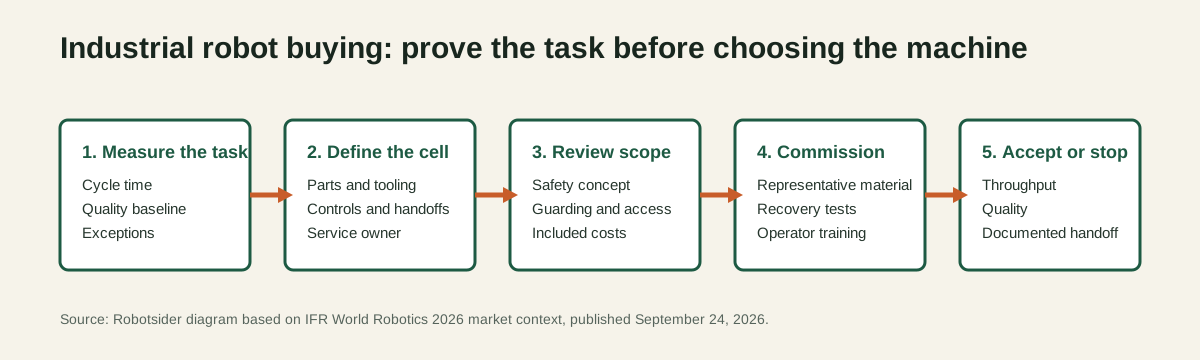
1. Describe the task, parts, tooling, quality standard and exception path. 2. Give the measured baseline: cycle time, scrap or rework, staffing, shifts and planned downtime. 3. Define the cell boundary, including conveyors, fixtures, vision, controls and data interfaces. 4. Name the intended users, access conditions, changeover needs and maintenance owner. 5. Ask for a safety concept and a completed-system assessment plan, not a product-level assurance. 6. Set an acceptance test with representative materials, a defined duration and named measures for throughput, quality and recovery.
For the safety work, start with our ISO 10218 buyer guide. The standards and legal duties depend on the system and jurisdiction. A supplier's marketing claim cannot establish that the final cell is safe or compliant.
How should a team decide whether to proceed?
Proceed when the team can demonstrate a stable task, defined cell boundary and testable acceptance criteria. Pause when the business case depends on unmeasured throughput, a supplier's unsupported labor claim or a safety plan that begins after the purchase order. The market is large. Your evidence still has to fit one site.
Industrial robot buying: common questions
Does a rising industrial robot market mean a robot will pay back at my factory?
No. Market growth does not establish a local business case. Measure the task baseline, then obtain a proposal that names the full cell scope, acceptance test and support obligations.
What should an industrial robot quote cover?
Ask the supplier to state whether the price covers the robot, end effector, fixtures, guarding, controls, integration, commissioning, training, spares and ongoing support. Treat unlisted items as unresolved.
Are annual installations the same as robot stock?
No. Installations count robots added during a year. Operational stock counts robots in use. Neither statistic tells a buyer how a specific cell will perform.
Why should a buyer care about regional installation data?
It can help identify where experience and demand cluster. It cannot prove local service coverage, regulatory fit or a financial return for a specific project.
Sources
- https://ifr.org/ifr-press-releases/news/five-million-robots-now-operate-in-factories-globally
- https://ifr.org/downloads/press_docs/EN-2026-SEP-24-IFR_Press_Release_WR-USA.pdf
- https://ifr.org/downloads/press_docs/EN-2026-SEP-14-IFR_Press_Release_WR-EU-27.pdf
- https://ifr.org/downloads/press_docs/EN-2026-SEP-24-IFR_Press_Release_WR-CHINA.pdf
- https://ifr.org/downloads/press_docs/Market_Presentation_WR_Press_Conference_2026.pdf