Isaac ROS 5.0 Upgrade: Should You Do It?
Isaac ROS 5.0 adds ROS 2 Lyrical support and CUDA buffer workflows. Use this guide to decide if your robot stack is ready.
An Isaac ROS 5.0 upgrade makes sense when a robotics team is already planning for ROS 2 Lyrical and Ubuntu 24.04, or needs to test GPU-resident message transport in a CUDA-heavy graph. NVIDIA released Isaac ROS 5.0 on September 22 with Lyrical support, new agent-oriented workflows, and updated packages.[1]
Do not upgrade for a promised frame-rate gain. The new CUDA buffer path only applies when its runtime conditions hold, and a package installation cannot prove that a robot's cameras, middleware, container images, or recovery path still work. Treat this as a measured platform change.
Is Isaac ROS 5.0 the right upgrade for your robot?
Isaac ROS 5.0 is the right upgrade when the project needs its ROS 2 Lyrical and Ubuntu 24.04 support, then has capacity to validate its actual robot graph. NVIDIA describes the release as a collection of GPU-accelerated packages built on ROS, with new agentic workflows and platform support.[1]
That scope matters. Isaac ROS packages cover functions such as localization, reconstruction, trajectory planning, pose estimation, and tracking. NVIDIA's own learning material frames them as a toolkit that integrates acceleration into ROS 2, not a complete robot application.[4]
Start with the dependency question. A team on another ROS distribution should plan the distribution and operating-system migration before it expects any benefit from the new transport path. A team already on the target platform can run a small pilot around one representative perception or inference pipeline.
| Adoption signal | Upgrade pilot is reasonable | Hold or separate the work | Evidence checked 2026-09-23 |
|---|---|---|---|
| Platform | ROS 2 Lyrical and Ubuntu 24.04 are an approved target. | The current robot image depends on a different platform and has no migration plan. | NVIDIA Isaac ROS 5.0 release. |
| Workload | A CUDA-accelerated node moves large, variable-length message data. | The graph has no relevant CUDA path or its bottleneck is elsewhere. | NVIDIA CUDA buffer tutorial. |
| Test capacity | The team can profile transport and run a full robot regression. | There is no rollback image, representative hardware, or acceptance test. | Robotsider recommendation based on NVIDIA's documented conditions. |
| Integration | Container, RMW, sensor, and deployment dependencies are inventoried. | Compatibility is being assumed from a successful package install. | NVIDIA Isaac ROS product and learning pages. |
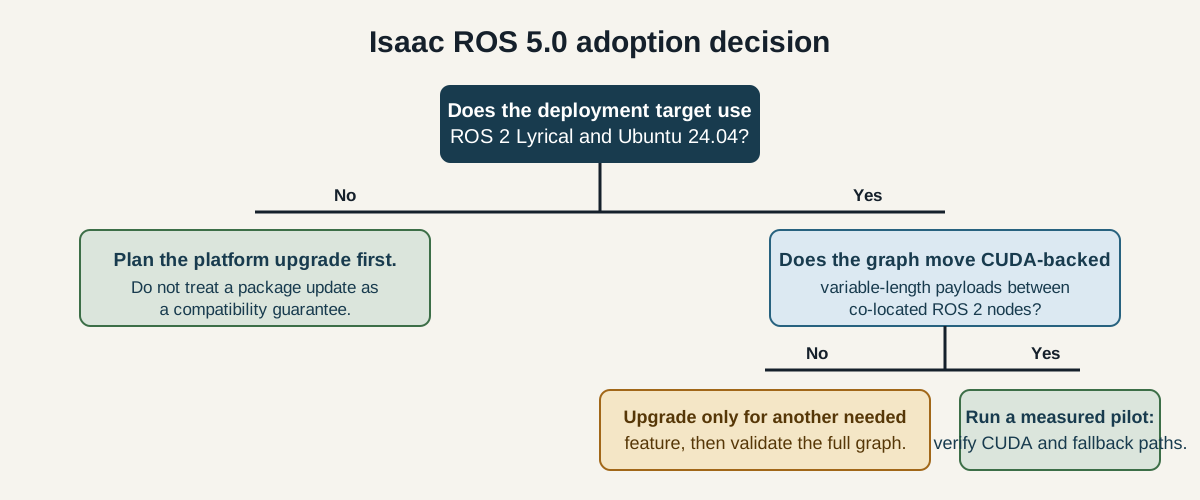
What does the CUDA buffer backend change?
The CUDA buffer backend can let compatible ROS 2 Lyrical nodes exchange GPU-resident, variable-length primitive-array payloads without serialization or host copies at their boundary. NVIDIA says it uses `rosidl::Buffer` with CUDA Virtual Memory Management while preserving the standard ROS message interface.[2]
This is a data-movement change, not a blanket acceleration switch. NVIDIA says the optimized path requires the same host, CUDA device, Linux user, and a supported RMW implementation, including examples such as `rmw_fastrtps_cpp` and `rmw_zenoh_cpp`. If those conditions are not met, ROS 2 falls back to the CPU-compatible path.[2]
The practical target is a graph where a GPU already performs useful work and the payload crosses enough node boundaries to make copying worth investigating. A node that waits on a camera, storage, network, or actuator cycle may need a different improvement first.
A faster CUDA kernel does not establish a faster ROS 2 graph. Inspect how its messages move between nodes.
NVIDIA positions NITROS as its implementation of type adaptation and negotiation for hardware-accelerated ROS processing pipelines. Its product page says the system can help ROS 2 graphs use GPU acceleration more efficiently, but it does not publish a single performance result that applies to every robot graph.[3]
How should a team validate the upgrade?
Validate Isaac ROS 5.0 with a test that proves both the intended CUDA path and a safe fallback path on the production-like robot. NVIDIA's tutorial recommends checking `msg->data.get_backend_type()` for `"cuda"` when endpoint conditions are met and using Nsight Systems to look for payload-sized host-device transfers at the ROS boundary.[2]
Begin with a repeatable baseline. Record the camera format and frame rate, inference latency, end-to-end message latency, CPU and GPU utilization, dropped frames, memory behavior, restart behavior, and the existing CPU-path result. Then change one node or pipeline boundary at a time.
For an update plan, use this sequence:
1. Build the target Isaac ROS 5.0 workspace in an isolated image and retain the current image unchanged. 2. Run the unchanged robot workload, including sensor initialization, time synchronization, recording, and a controlled restart. 3. Migrate one CUDA-accelerated node only if its message fields and endpoints fit the documented buffer-backend conditions. 4. Confirm the backend type and inspect a trace for the expected absence of payload-sized boundary transfers. 5. Force or observe a CPU fallback, then repeat the robot task so an incompatible peer does not become an untested failure mode. 6. Compare results against the baseline and keep the new image only when the task-level acceptance criteria pass.
A robotics team choosing its target distribution can compare ROS 2 Lyrical and Jazzy before committing to the operating-system work. Teams using NVIDIA edge hardware can also review Jetson Thor versus AGX Orin as a hardware planning reference. Neither guide certifies compatibility with a particular Isaac ROS graph.
When should you skip the CUDA migration work?
Skip the CUDA migration work when the graph does not have compatible GPU-resident payload traffic, or when the team cannot measure it on representative hardware. Isaac ROS still offers modular ROS 2 packages for perception, navigation, and related tasks. Another needed feature may support an upgrade, but that is a separate decision.[3][4]
A simple graph may gain more from fixing sensor exposure, timestamp alignment, QoS settings, executor behavior, or a slow inference model. Do not create a transport project because a release note exists. Start with the bottleneck that a trace or task test actually shows.
The same restraint applies to AI-assisted migration. NVIDIA's release includes reusable skills and agent-ready documentation, but generated code or a clean build does not replace profiling, regression tests, and review of resource ownership in the robot stack.[1][2]
The upgrade is most credible as a narrow pilot with a named success condition. Keep the CPU path testable. If the CUDA path cannot be shown on the actual graph, retain the compatibility path and revisit the work when the measurement case is stronger.
Frequently asked questions
Should I upgrade to Isaac ROS 5.0 for every ROS 2 robot?
No. Upgrade when ROS 2 Lyrical and Ubuntu 24.04 are a planned target or when a measured CUDA transport pilot addresses a real graph bottleneck. Validate the full robot workload after the change.
Does Isaac ROS 5.0 guarantee zero-copy GPU message transport?
No. NVIDIA says the CUDA buffer path depends on compatible co-located endpoints, the same CUDA device and Linux user, plus a supported RMW implementation. Otherwise ROS 2 uses a CPU-compatible fallback.[2]
How can I check whether the CUDA transport path is active?
NVIDIA's tutorial says to inspect `msg->data.get_backend_type()` for `"cuda"` when conditions are met and to use Nsight Systems to inspect host-device transfers at the ROS boundary.[2]
Is a faster ROS transport path evidence that the robot is safe to deploy?
No. Transport measurements do not validate task behavior or safety controls. Test those separately on the intended robot and application.
Sources
- https://blogs.nvidia.com/blog/isaac-ros-5-0-agentic-open-source-robotics/
- https://developer.nvidia.com/blog/accelerating-a-ros-2-node-with-an-ai-agent-and-nvidia-isaac-ros
- https://developer.nvidia.com/isaac/ros
- https://docs.nvidia.com/learning/physical-ai/getting-started-with-isaac-ros/latest/an-introduction-to-ai-based-robot-development-with-isaac-ros/04-what-is-isaac-ros.html