Kawasaki CP110L Palletizer Buying Guide
Kawasaki's CP110L arrives in North America with a 110 kg payload. Use this guide to check cell fit, case rate and integration scope before buying.
The Kawasaki CP110L palletizer is worth putting on a shortlist when a line needs a 110 kg class, floor mounted palletizer but has limited ceiling or floor clearance. Kawasaki says it will make its North American debut at PACK EXPO International in Chicago on October 18 to 21. The robot is not a turnkey cell, and Kawasaki does not disclose a robot price.[1]
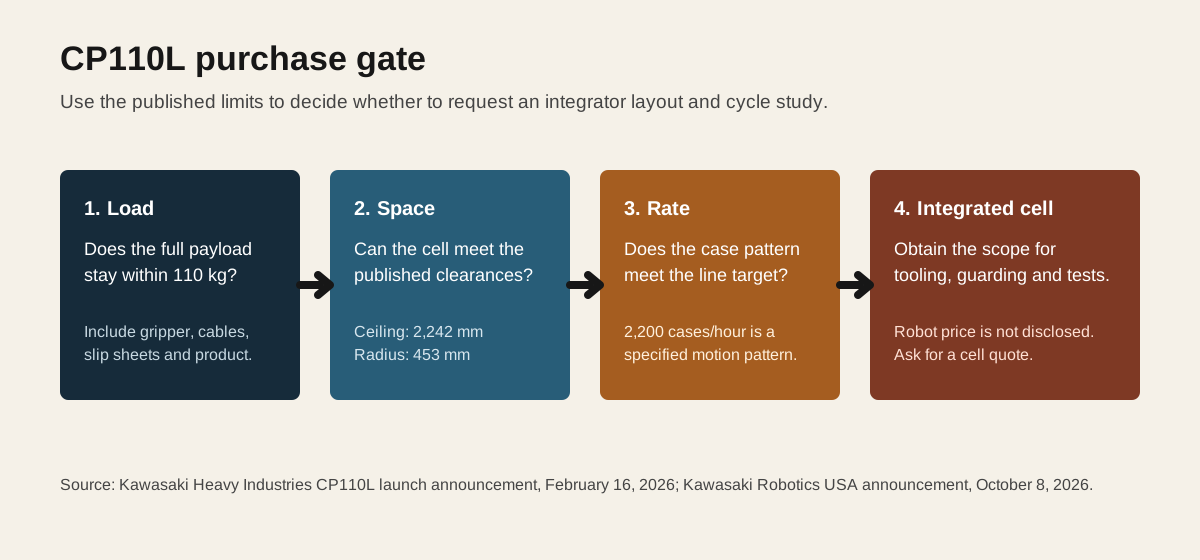
Start with the payload including the end of arm tool, then ask an integrator to test the actual case pattern, pallet geometry and guard layout. Kawasaki's 2,200 cases per hour figure applies to a named reciprocal motion pattern with a 60 kg load including the hand. It is useful evidence, not a line guarantee.[2]
Is the Kawasaki CP110L palletizer the right size?
The Kawasaki CP110L palletizer fits a project only when the full handled mass stays inside its 110 kg rating and the reach covers every pick and placement point. Kawasaki lists 110 kg payload and 2,505 mm maximum reach. Its published figure includes neither a promise about a particular product nor a substitute for an application layout.[3]
Count what the wrist carries. That means the gripper or clamp, product, slip sheet where applicable, cables or pneumatics that move with the tool, and a realistic allowance for variants. A case that weighs 95 kg does not automatically fit a 110 kg robot after tooling is added.
| Check before requesting a quote | Kawasaki published value | What the buyer still needs to establish |
|---|---|---|
| Maximum payload | 110 kg | Combined mass of product and end of arm tooling |
| Maximum reach | 2,505 mm | Farthest pick, pallet corner and clearance position |
| Axes | 4 | Whether the required orientation and case pattern need extra motion or tooling |
| Repeatability | plus or minus 0.05 mm | Cell performance after product, tooling and conveyor variation |
| Robot mass | 820 kg | Foundation, access and installation plan |
Specifications: Kawasaki Heavy Industries CP110L launch announcement, checked October 9, 2026.[2]
For a wider safety and integration checklist, see our cobot safety standards buyer guide. A palletizer cell needs a risk assessment for the complete installation, not an inference from robot repeatability.
Will the CP110L fit the palletizing cell?
The CP110L's published compact dimensions make it a candidate for a constrained end of line, but they do not prove that it fits your line. Kawasaki states a required ceiling height of 2,242 mm at maximum reach and a 453 mm revolute-axis interference radius. Those are geometry inputs for the layout review.[2]
Kawasaki also describes a hollow wrist that routes cables through the wrist interior. That may reduce external cable interference around the wrist, but the selected tool, hose bend radius, guards and maintenance access still set the usable cell envelope.[2]
Can the Kawasaki CP110L palletizer meet the line rate?
The Kawasaki CP110L palletizer can move 2,200 cases per hour under Kawasaki's stated test condition: a 60 kg payload including the hand, with a 400 mm rise, 2,000 mm horizontal transfer and 400 mm descent. Treat that as a comparison point. Product dimensions, grip time, pallet pattern, conveyor handoff and pauses can change the delivered rate.[2]
The North American launch announcement repeats the 2,200 cases per hour figure and says the CP110L targets packaging, consumer packaged goods and end of line automation. It also places the machine at PACK EXPO booth N-5933, where a buyer can ask for the motion assumptions and an application-specific demonstration.[1]
Ask the integrator for a cycle study that states:
1. Case dimensions, mass range and surface condition. 2. Tool type, grip confirmation and any regrip logic. 3. Pallet pattern, layer changes, slip sheets and empty pallet handling. 4. Conveyor speeds, accumulation, interface signals and stop conditions. 5. The definition of sustained rate, including recovery and planned pauses.
Kawasaki's EMEA material describes the CP110L as able to process more than 2,200 cartons per hour, while the February launch explains the named 60 kg test condition. The second source is the more useful basis for a cycle discussion because it supplies the motion path.[2][4]
What does a CP110L project cost?
Kawasaki lists the CP110L's domestic sales price as "Open Price" and does not disclose a North American robot price in the October 8 announcement. Do not turn the published robot specifications into a total cost estimate.[1][2]
The purchase scope needs a quote for the full cell: robot and controller, end of arm tooling, conveyors or pallet interfaces, safeguarding, controls integration, installation, commissioning, training, spare parts and acceptance testing. Energy use can also depend on the motion profile and system design. Kawasaki says the robot has a standard power regeneration function, but it does not publish a site-specific energy bill or savings figure.[2]
This is also where a buyer should separate equipment capability from a deployment promise. An industrial controller, a robot arm and a safety system form one installation. Our industrial robot density explainer gives useful context for why automation counts do not reveal the performance of an individual cell.
Should you see the CP110L at PACK EXPO?
See the CP110L at PACK EXPO if its payload and space claims match a real project and you can bring an application brief. Kawasaki says the North American launch takes place at PACK EXPO International, October 18 to 21, 2026, at McCormick Place in Chicago.[1]
Bring case samples or exact dimensions, the heaviest configuration, pallet pattern, target rate, ceiling height, available floor plan and the existing conveyor controls. Ask the demonstrator to distinguish published maximums from the demonstrated application. The right outcome is not a quick order. It is a credible layout and cycle study for the actual line.
Frequently asked questions
What is the Kawasaki CP110L payload?
Kawasaki lists a maximum payload of 110 kg. The payload calculation must include the end of arm tool and all moving attachments, not only the product weight.[2]
How fast is the Kawasaki CP110L palletizer?
Kawasaki publishes 2,200 cases per hour under a stated reciprocal motion pattern with a 60 kg payload including the hand. Actual cell rate depends on product, tool, pallet pattern and conveyor interfaces.[2]
What is the Kawasaki CP110L price?
Kawasaki lists the domestic sales price as Open Price and does not disclose a North American robot price in its October 8 launch announcement. Request a cell quote from an integrator.[1][2]
Where will Kawasaki show the CP110L in North America?
Kawasaki says the CP110L will make its North American debut at PACK EXPO International 2026, October 18 to 21, at McCormick Place in Chicago, booth N-5933.[1]
Sources
- https://prnewswire.com/news-releases/kawasaki-robotics-to-launch-cp110l-palletizer-in-north-america-at-pack-expo-302902460.html
- https://global.kawasaki.com/en/corp/newsroom/news/detail/?f=20260216_4386
- https://kawasakirobotics.com/uk/products-robots/cp110l/
- https://kawasakirobotics.com/emea/interpack2026/