Dream-1 Robot API Opens With $90M Seed Funding
Dream Labs opened its Dream-1 robot API after raising $90 million. The public beta targets bimanual gripper robots, not every robot task.
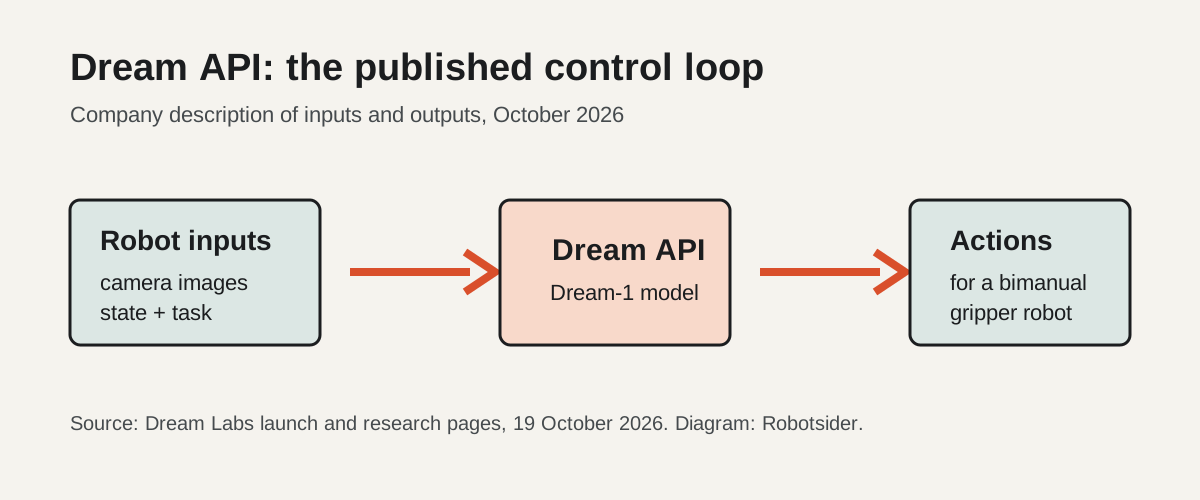
Dream Labs has opened the Dream-1 robot API alongside a $90 million seed round. The company says the public beta turns camera observations, robot state and a task instruction into actions for bimanual robots with parallel grippers. It is a hosted control model, not a complete robot or a proof that it will work on every deployment.[1][2]
What did Dream Labs launch?
Dream Labs launched a hosted API for Dream-1, its first World Action Model. Developers can send visual observations, the robot's current state and a task, then receive a short action sequence. Its site also links to a browser playground and a fine-tuning service for a specific robot body.[3]
B Capital and Kindred Ventures led the funding, according to the company's October 19 release.[2] Dream Labs says it intends to spend the capital on compute. It also says it has more than 20 hardware partners. The release provides no independent deployment evidence.[2]
"We're giving people a working model they can test themselves, mistakes included."[2]
The launch builds on DreamZero, a February research project that describes World Action Models as systems that jointly predict future world states and actions from video. That earlier work is technical context, not a validation of the commercial API.[5]
What robots and tasks does Dream-1 cover?
Dream-1 currently targets tabletop manipulation on two-armed robots with parallel grippers. Dream Labs lists picking, placing and folding among the current tasks. The company plans later support for wheeled mobile robots and dexterous hands.[1][2]
That boundary matters more than the launch language. A customer with a single arm, a mobile base, a dexterous hand or a safety-sensitive task should not read the API announcement as a deployment guarantee. Dream Labs says behavior varies across robots and notes that the robot's inverse-kinematics solver affects zero-shot behavior.[1]
The research page reports simulations across 27 unseen robots and shows real-robot clips from bimanual gripper systems. It also says adaptation can improve some robot bodies while reducing results for others. Readers assessing control maturity should separate those company-published tests from an operating record at a working site.[1]
For a different way to describe robot capability without collapsing it into one score, see the Arm Robotics Capability Framework. For hardware context, our Jetson Thor versus AGX Orin guide covers developer compute instead of control-model claims.
What does the $3 hourly price include?
Dream Labs lists Dream-1 at $3 per hour and Dream-1-flash at $2 per hour. It says a model call returns 1.6 seconds of actions and describes an hour as 2,250 calls. The published rate is for model access, not a price for completed work.[1]
A buyer still needs compatible hardware, cameras, networking, an inverse-kinematics stack, integration and a safe recovery process when the robot fails a task. Dream Labs offers fine-tuning for unsupported hardware or capabilities outside the baseline scope, but it has not published a price list for that service.[1][2]
Robocurve's public run index shows results and outcomes across several benchmarks, but the general listing does not by itself establish a production reliability figure for Dream-1.[4] That is the sensible gap to watch as the beta moves from demonstrations to repeatable work.
Dream-1 robot API questions
What is the Dream-1 robot API?
It is Dream Labs' public API for sending a robot's observations, state and task to Dream-1 and receiving action outputs. The company launched it on October 19, 2026.
What robots does Dream-1 support?
Dream Labs states that its zero-shot baseline is for bimanual robots with parallel grippers. It also offers fine-tuning for other hardware and capabilities.
How much does Dream-1 cost?
Dream Labs lists Dream-1 at $3 per hour and Dream-1-flash at $2 per hour. Those rates do not include the robot, integration or operational support.
Is Dream-1 ready for safety-sensitive work?
Dream Labs describes Dream-1 as a research beta and says performance varies across robots. The launch materials do not provide a safety certification or a general production reliability claim.
Sources
- https://dreamlabs.ai/research/dream-1/
- https://www.businesswire.com/news/home/20261019230613/en/Dream-Labs-Raises-%2490M-Seed-to-Build-the-Brain-for-Everyday-Robots
- https://dreamlabs.ai/
- https://robocurve.org/all-runs/?leaderboard=dream-1
- https://dreamzero0.github.io/