Intrinsic Core Open Source Robotics Stack
Intrinsic Core is now open source, bringing ROS-compatible control, planning and simulation tools to industrial robotics developers.
Intrinsic Core open source robotics software is now available as a ROS-compatible environment for industrial applications. Announced at ROSCon 2026 in Toronto on September 22, the package includes local runtime services, an SDK and a hardware-agnostic real-time control framework under the Apache 2.0 license.[1][3]
The release matters to developers building manipulation systems because it bundles control, perception, planning and simulation pieces that teams otherwise assemble separately. It is a software release, not evidence that a finished workcell will perform safely in a particular factory.[1]
What does Intrinsic Core include?
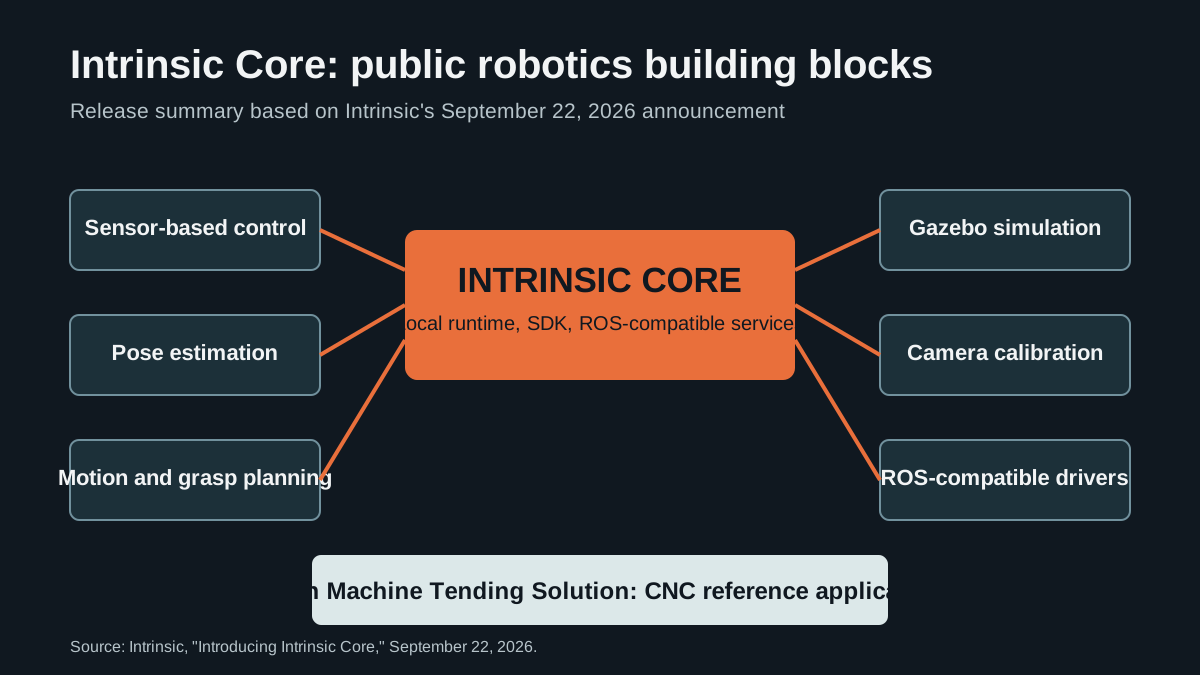
Intrinsic Core open source robotics tools cover sensor-based control, pose estimation, motion planning, grasp planning, Gazebo-backed simulation, camera calibration and preconfigured ROS-compatible drivers. Intrinsic says the environment runs on local hardware and includes asset models plus a digital twin.[1]
Its control layer can adjust a robot trajectory from sensor feedback, according to Intrinsic. The company says it designed the framework to let developers exchange robot arms, grippers and sensors without rewriting drivers.[1] That is a vendor claim about the framework's intended abstraction, not a compatibility guarantee for every device.
"What we're sharing this week is the core of our own software stack," Intrinsic CTO Brian Gerkey said of the release.[1]
The project is public on GitHub, where the repository describes an open, local runtime and SDK for industrial robotics and lists Apache 2.0 as its license.[3]
Why is machine tending the first reference application?
The Open Machine Tending Solution gives developers a CNC machine-tending reference application rather than a generic demo. It runs with Intrinsic Core and the Open Robotics Suite, and Intrinsic says developers can customize it for hardware from FANUC and Universal Robots.[1]
The reference design uses NVIDIA FoundationPose for object registration, tracking and pose estimation, according to NVIDIA's ROSCon release coverage.[4] It can help an engineering team test a workcell concept, but it does not replace cell safety design, risk assessment, integration validation or acceptance testing.
For a related controller approach, see our FANUC R-50iA Compact DC Controller coverage. Teams choosing the surrounding software base can also compare ROS 2 Lyrical and Jazzy.
What remains outside the open release?
Intrinsic says applications built with Core can work with its enterprise offerings, including advanced AI models, Flowstate and industrial-grade cloud services.[1] The company has not said that the Apache-licensed repository includes those enterprise services.
That boundary is important for procurement and architecture reviews. The public code provides a starting point, while production deployment still requires a tested hardware combination, security controls, safety functions and a support plan.
Intrinsic Core open source robotics questions
Is Intrinsic Core open source?
Yes. Intrinsic released Intrinsic Core under the Apache 2.0 license on September 22, 2026. The public GitHub repository identifies the project as an open, local runtime and SDK for industrial robotics.
Is Intrinsic Core compatible with ROS?
Intrinsic describes Core as ROS-compatible and says it works with the Open Robotics Suite. The release includes preconfigured ROS-compatible drivers for supported robots, grippers and 3D cameras.
What is the Open Machine Tending Solution?
It is Intrinsic's open reference application for CNC machine tending. The company says it runs on Intrinsic Core and the Open Robotics Suite and developers can customize it for selected hardware.
Does open source Core include every Intrinsic service?
No such claim appears in the cited release. Intrinsic separately identifies advanced AI models, Flowstate and industrial-grade cloud services as enterprise offerings.
Sources
- https://www.intrinsic.ai/blog/posts/introducing-intrinsic-core
- https://www.intrinsic.ai/intrinsic-core
- https://github.com/intrinsic-ai/intrinsic-core
- https://blogs.nvidia.com/blog/isaac-ros-5-0-agentic-open-source-robotics