Volvo NVIDIA Automated Driving: Buyer Guide
Volvo NVIDIA automated driving claims are future-facing. This guide separates announced hardware, driver assistance and an available automated-driving offer.
Volvo NVIDIA automated driving claims became more ambitious on October 15, when the companies said future Volvo cars would use NVIDIA Hyperion hardware, Halos OS and Alpamayo Stack software for door-to-door driving. Buyers should treat that as an announced development program, not an available automated-driving feature.[1]
The useful question is narrower: what can the exact car do now, in which conditions, and who must monitor it? NHTSA says even the highest level of driving automation currently available to consumers requires a fully engaged, attentive driver.[2]
What did Volvo and NVIDIA announce?
Volvo and NVIDIA announced an expanded partnership for future Volvo cars. The release says the intended stack includes NVIDIA Hyperion sensor and compute architecture, Halos OS and Alpamayo Stack driving software, with a gradual introduction of eyes-off and mind-off driving. It does not name the first vehicle, a release date, a geography or conditions where the function would operate.[1]
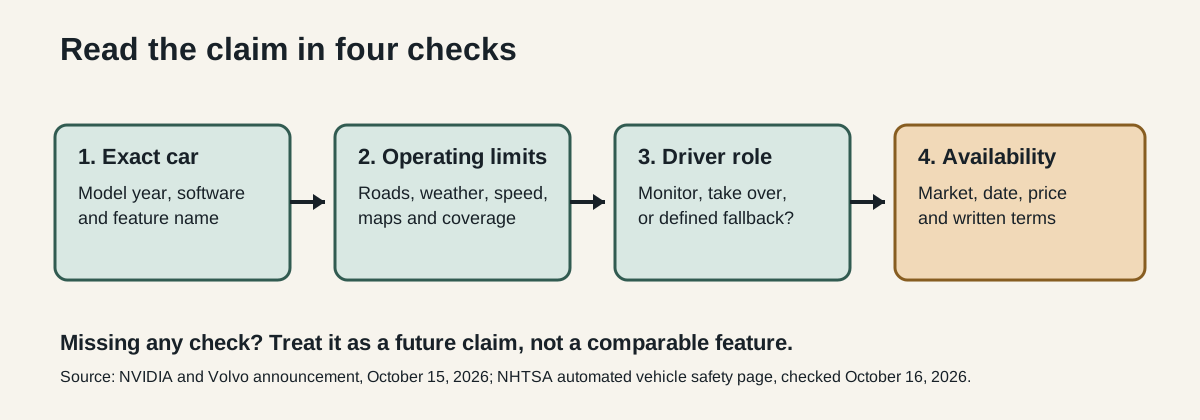
That missing detail matters more than the product names. A buyer cannot compare a future automated-driving claim with an existing driver-assist feature until the company states the permitted roads and conditions. It must also say whether a human must take over and how the vehicle handles its limits.
Is a powerful computer proof of automated driving?
No. A computer specification says something about available processing capacity, not that a vehicle can drive itself in a stated set of conditions. Volvo says every 2026 EX90 gains a dual NVIDIA DRIVE AGX Orin core computer rated at 500 TOPS.[3] Its listed functions include connected safety alerts. They also include automatic emergency steering in darkness and Emergency Stop Assist.[3]
Those functions are concrete, but they are not the same statement as a door-to-door automated-driving service. The October partnership release concerns a next-generation Volvo car, while Volvo's EX90 announcement concerns a named model-year vehicle and named features.[1][3]
| Question for the seller | Evidence that answers it | What does not answer it |
|---|---|---|
| Can this exact vehicle drive without a supervising driver? | The feature manual, terms of use and local availability statement. | A partnership announcement or a chip rating. |
| Where can it operate? | A written operational design domain: roads, weather, speed, maps and geographic coverage. | A broad phrase such as "door-to-door." |
| What happens at a limit? | A documented fallback, warning and driver-response requirement. | A demo route without the same conditions. |
| What does it cost and when does it arrive? | A dated price, market list and delivery terms. | An unspecified future product plan. |
The table is a buyer checklist, not a statement that Volvo has supplied each item. The current releases do not disclose all of those details.[1][3]
How should buyers separate assistance from automation?
Start with the driver's job, not the label. NHTSA describes driver-assistance technologies as systems that warn a driver or take action to avoid a crash. It says current consumer technology, including the highest level of driving automation available to consumers, still requires the driver to stay fully engaged and attentive.[2]
A useful buying record should state the exact vehicle, software version, country, feature name and date checked. Then capture the monitoring rule in the same record. A function that works on selected roads, in a selected market or only while the driver watches remains a different proposition from a service that assumes the driving task under defined conditions.
This distinction resembles the system-boundary problem in industrial automation. Our cobot safety standards guide explains why a claim about one component does not settle safety for the complete application. The same discipline applies here: processor, sensors, software, vehicle, road and driver obligations all belong in the assessment.
What should you request before treating the claim as a buying factor?
Ask the seller for a feature-specific answer, not a product-family summary. The direct answer is simple: if it cannot provide the operating conditions, driver role and availability for the exact car, it should not decide your purchase.
1. What is the exact model, model year and software version? 2. In which countries and roads is the feature available today? 3. Must the driver monitor the road, remain ready to take over, or be able to resume control within a stated time? 4. What weather, lighting, speed, road-type and map-coverage limits apply? 5. What does the vehicle do if a camera, sensor, map or software condition falls outside those limits? 6. Is the function included, a subscription or a future update? Request the price and date in writing.
These are due-diligence questions, not legal or safety advice. They prevent a buyer from treating architecture and intent as a delivered capability. Our EU machinery regulation explainer is a separate example of why the applicable rules depend on the product and jurisdiction.
What is the practical verdict for a Volvo buyer?
Treat the Volvo-NVIDIA announcement as a reason to watch future product documents, not a reason to assign a value to a car today. The 2026 EX90 has a disclosed NVIDIA-based computer and named driver-assist features. The future door-to-door claim needs a named vehicle, defined operating conditions and a clear statement of the driver's role before it becomes comparable.[1][3]
For the same reason, do not use a single specification to stand in for system behavior. Our guide to robot mower slope ratings makes a related point: a headline limit is useful only when its measurement conditions are clear.
Volvo NVIDIA automated driving questions
Did Volvo launch door-to-door automated driving?
No. Volvo and NVIDIA announced work on future Volvo cars and said the technology would debut in a next-generation car. The release did not name the first vehicle, launch date, price, markets or operating conditions.[1]
Does the 2026 Volvo EX90 have the announced future automated-driving stack?
Volvo says the 2026 EX90 gains a dual NVIDIA DRIVE AGX Orin-based core computer and named safety and driver-assist functions. The separate Volvo-NVIDIA release describes future technology for a next-generation vehicle.[1][3]
Does a 500 TOPS computer mean a car can drive without supervision?
No. Processing capacity does not state the permitted roads, weather, driver role, fallback behavior or legal availability. NHTSA says current consumer automation still requires a fully engaged, attentive driver.[2][3]
What should a buyer ask about an automated-driving feature?
Ask for the exact car and software version, countries and roads, operating limits, driver-monitoring rule, fallback behavior, price and availability date. Treat an unavailable or unspecified item as unconfirmed.
Sources
- https://nvidianews.nvidia.com/news/volvo-cars-and-nvidia-expand-partnership-to-advance-safe-automated-driving
- https://www.nhtsa.gov/technology-innovation/automated-vehicles-safety
- https://media-downloads.volvocars.com/4f038892-f203-4439-9b78-b37900eff633/volvo-car-usa-announces-major-upgrades-and-new-2025-10-29-173008-684.pdf?apr_download=true&apr_optimization=false