Professional Service Robot Sales Rise 24%, IFR Says
IFR reports under 250,000 professional service robots sold in 2025. Transport and logistics led, but this is not a count of every robot worldwide.
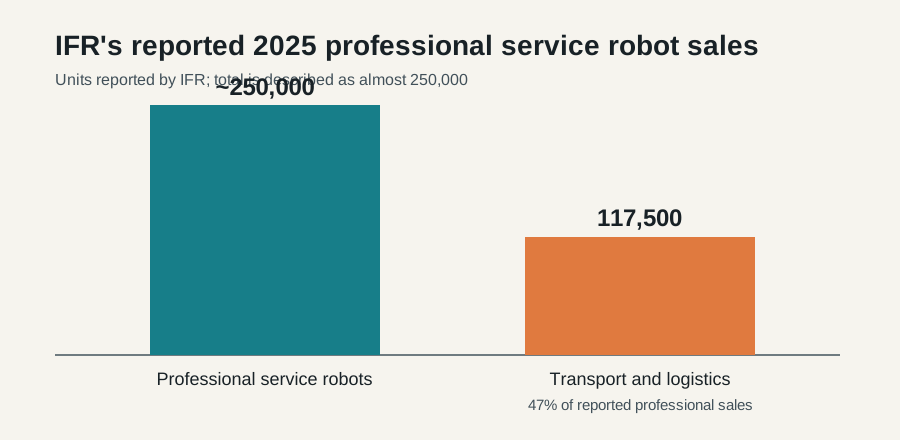
Professional service robot sales rose 24% to fewer than 250,000 units in 2025, according to the International Federation of Robotics. Transport and logistics was the largest application in IFR's count, with 117,500 units. The update is market evidence, but it does not turn into a census of every robot shipped worldwide.[1]
What did IFR report for professional service robots?
IFR's new release puts professional service robot sales below 250,000 units for 2025, 24% above its reported prior-year total. Its transportation and logistics category supplied 117,500 units and a 47% share. Hospitality ranked second, while professional cleaning ranked third, but the release does not give unit totals for those two groups.[1]
The release describes the leading category as robots used for transportation, material flow automation, and delivery processes. That scope includes more than warehouse picking. A buyer comparing this number with a factory robot total needs to keep the categories separate. IFR's industrial statistics use a different reporting series, and service data can include mobile equipment and application-specific systems.[2]
"Transportation and logistics stays in the lead as top application, with 117,500 units sold in 2025." [1]
IFR also reported sales of full-size humanoids, defined there as taller than 140 cm, for commercial and professional uses. The federation says current humanoid applications remain specialized and often require human teleoperation. It lists safety standards, training and maintenance costs, business cases, manipulation, and economic scaling among the barriers to wider use.[1]
For a closer look at the reporting boundary, read our explainer on what counts as a service robot. For industrial context, see how IFR's robot density measure works.
Why should readers treat the total carefully?
The headline figure is a reported sales total within IFR's professional service robot category. It is not an audited count of all robots in use. IFR bases its categories on ISO vocabulary and its own reporting refinements. A product's label alone cannot settle which dataset it belongs in.[2]
That distinction matters for AMRs and mobile manipulators. IFR's methodological material calls AMR a market term and classifies wheeled AMRs used in professional applications as service robots. If an AMR carries an articulated arm, IFR can count the platform as a service robot and the arm in industrial robot statistics. Adding published totals across those datasets can double count part of a system.[2]
The federation made an important caveat in its prior World Robotics service release: those figures were sample data, not projections to the whole industry, and the sample composition could change between editions.[3] The September 30 release does not state the 2026 sample size or publish its full method. Readers should call the total "reported by IFR," not a complete global shipment count.
The market signal is still clear inside the series: IFR recorded higher professional service robot sales and transport logistics remained its largest named application. The release does not disclose average selling prices, revenue, operating fleets, site counts, robot uptime, or task-level productivity. Those are different questions from units sold.
Professional service robot sales: common questions
What total did IFR report for professional service robots in 2025?
IFR reported professional service robot sales below 250,000 units for 2025, up 24% from its reported 2024 total.
Which professional service robot application led IFR's 2025 count?
Transportation and logistics led with 117,500 units, or 47% of the professional service robot total reported by IFR.
Do IFR's service robot figures count every robot sold worldwide?
No. IFR's earlier release calls its service figures sample data, not a projection to the whole industry. The 2026 release did not state a sample size.
Are AMRs industrial robots in IFR data?
IFR classifies wheeled AMRs used professionally as service robots. An attached articulated arm may appear in industrial robot statistics.
Sources
- https://ifr.org/ifr-press-releases/news/global-sales-of-professional-service-robots-surge-24-percent
- https://ifr.org/img/worldrobotics/Definition_Service_Robots_2026.pdf
- https://ifr.org/ifr-press-releases/news/service-robots-see-global-growth-boom